Habitat
 Depth
 Group
 Role
WHAT DOES IT LOOK LIKE?
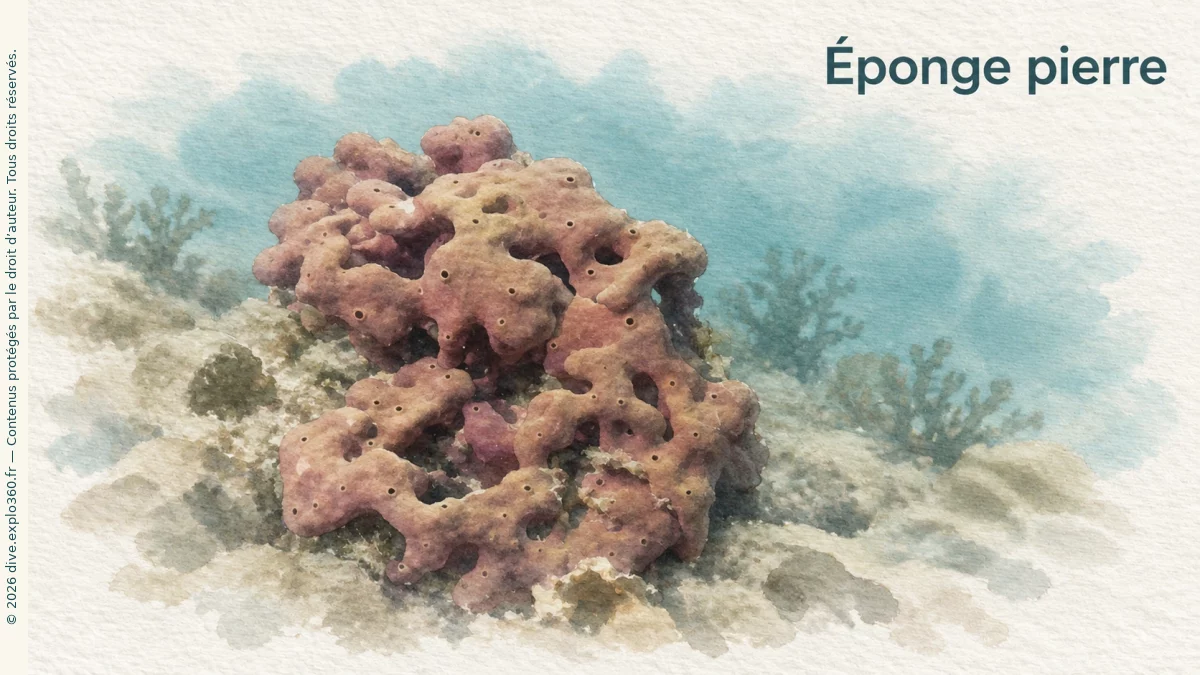
It forms irregular rounded, sometimes lobed masses of variable dimensions and thickness. Circular openings, the oscula, are distributed over the surface and let water out.
Usual pink-brown to wine-red colour partly comes from cyanobacteria, photosynthetic bacteria in illuminated outer tissues. Shaded parts or whole individuals may be very pale.
WHERE DOES IT LIVE?
It attaches to rocks, walls and overhangs, and at cave entrances or inside caves. These habitats occur along French Mediterranean coasts. Diving descriptions record it from shallow water to several tens of metres.
Light contrasts can occur within one animal. A white patch is therefore not automatically a wound. Interpretation needs exposure, surface state and any consumer present.
WHAT DOES IT EAT?
It filters microscopic food and organic particles from water. Specialised cells drive pumping through its internal network.
Microbial communities also live in the tissues. Light-associated cyanobacteria are only part of these. Distinguish resident microbes from recently captured food and avoid describing every partnership as an exchange identical to corals with algae.
GO FURTHER WITH AMIGANSEAU
Unlock the full profile
Deepen your knowledge with the exclusive chapters and interactive resources included in an AMIGANSEAU licence.
- HOW DOES IT REPRODUCE?
- OUR OBSERVATIONS
- ARTICLE
Also included in the full profile
- Advanced navigation between description, ecological context, observations and behaviour
- Interactive food chain to explore the species’ feeding relationships