Habitat
 Depth
 Group
 Role
 Average size
WHAT DOES IT LOOK LIKE?
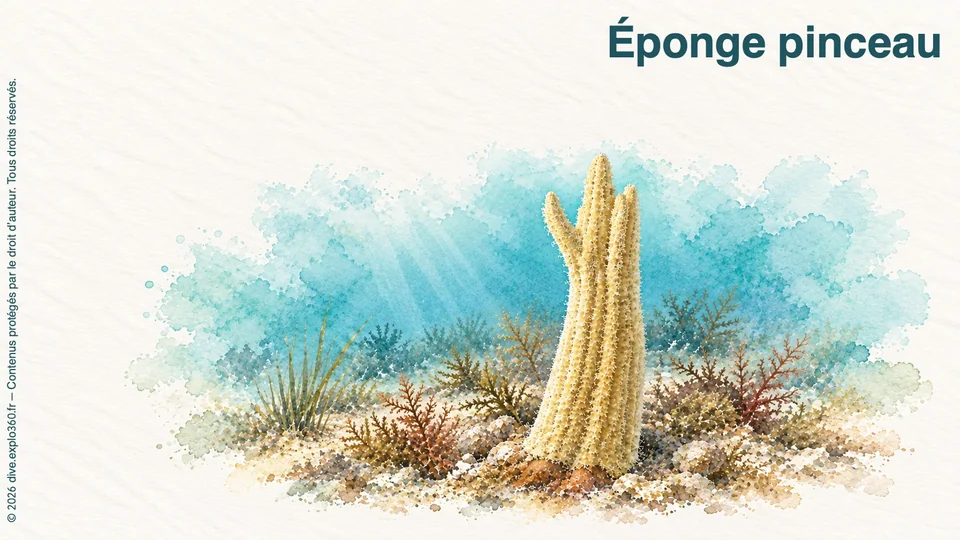
The cored chimney sponge (Ciocalypta penicillus) has cone-shaped projections called papillae. Each has a translucent, slightly ridged wall through which you can see its central core.
Creamy white, creamy yellow and grey shade these little brushes rising from a shared base. Their pale walls reveal the denser core of the projections.
WHERE DOES IT LIVE?
It occurs on stable soft bottoms such as shelly sand or maerl beds, as well as detrital substrates. It occurs in areas exposed to moderate currents.
WHAT DOES IT EAT?
The brush sponge feeds by filtering seawater. Internal cells trap bacteria and fine organic particles carried by the water. Its base is often buried in sand, while upright papillae remain visible. Some bear an osculum at the tip, an opening through which filtered water is expelled. Food is captured within the tissues, not by the papillae themselves.
GO FURTHER WITH AMIGANSEAU
Unlock the full profile
Deepen your knowledge with the exclusive chapters and interactive resources included in an AMIGANSEAU licence.
- HOW DOES IT REPRODUCE?
- OUR OBSERVATIONS
- ARTICLE
Also included in the full profile
- Advanced navigation between description, ecological context, observations and behaviour
- Interactive food chain to explore the species’ feeding relationships
- Infographic and illustrated summary profile
 Understand the species