Habitat
 Depth
 Group
 Role
WHAT DOES IT LOOK LIKE?
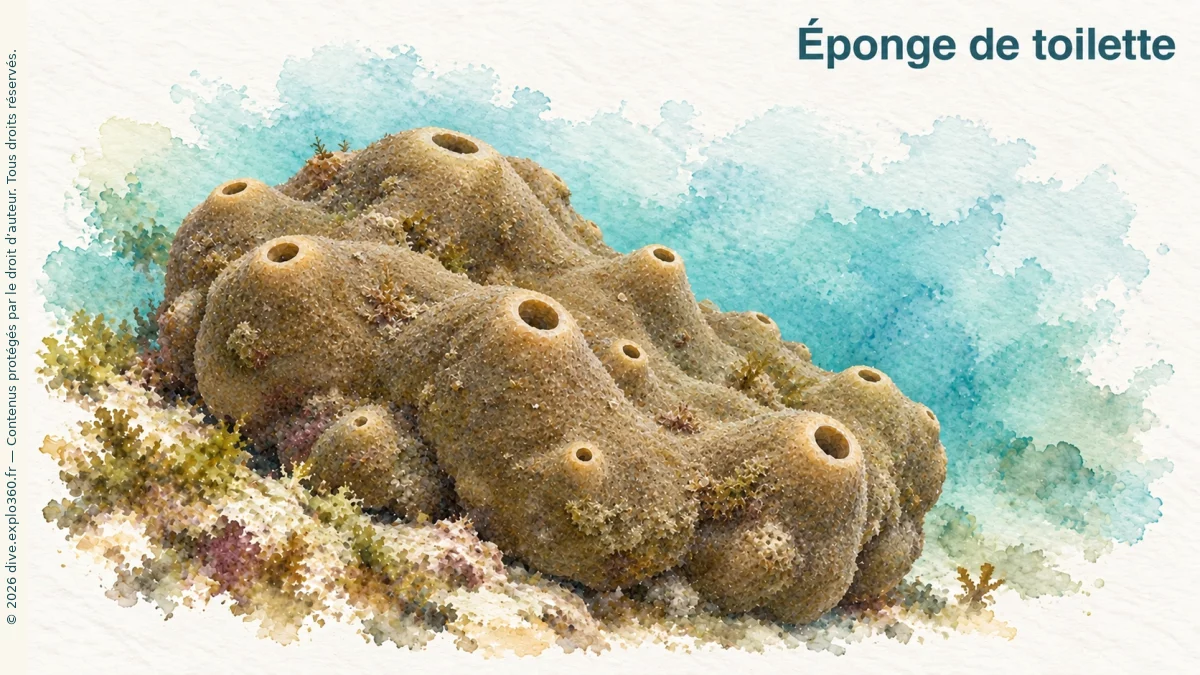
This sponge forms rounded or lobed masses, usually grey to dark brown. Its surface has fine bumps and water outlets, sometimes raised and edged with a pale rim. A network of flexible fibres supports the body beneath the living tissues.
WHERE DOES IT LIVE?
Mediterranean occurrence is documented, including Provence. Hard substrates, principally rock but also some seagrass rhizomes, permit attachment. DORIS spans shallow overhangs to records around 80 m. Conditions influence shape and colour. Old distant records need review rather than automatic worldwide extension of a commercially exploited name.
WHAT DOES IT EAT?
The aquiferous system moves water from microscopic inhalant pores to exhalant oscula. Choanocytes support pumping and resource capture. Bacteria, small cells and organic particles provide food. Large visible openings are not prey-entry mouths. Neither flow rate nor exact resource composition can be measured from an osculum photograph.
GO FURTHER WITH AMIGANSEAU
Unlock the full profile
Deepen your knowledge with the exclusive chapters and interactive resources included in an AMIGANSEAU licence.
- HOW DOES IT REPRODUCE?
- OUR OBSERVATIONS
- ARTICLE
Also included in the full profile
- Advanced navigation between description, ecological context, observations and behaviour
- Interactive food chain to explore the species’ feeding relationships