


 Habitat
 Depth
 Group
 Role
 Average size
WHAT DOES IT LOOK LIKE?
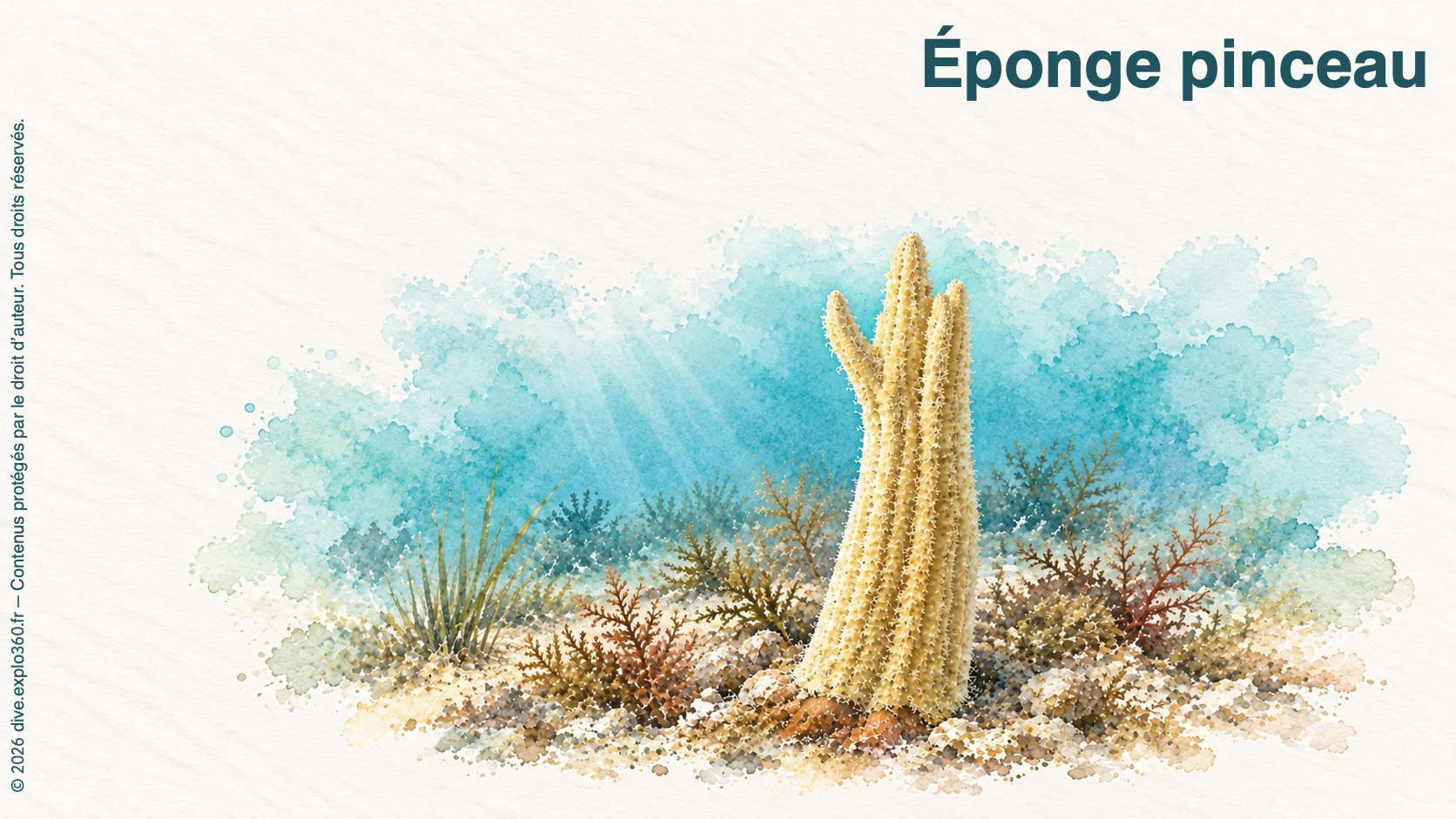
The yellow-tube sponge (Aplysina aerophoba) has finger-like tubes rising from a bulky base. Each tube has a flat top with a visible central opening called an osculum.
The strength of the yellow colour varies. Small conical points and elongated outgrowths add relief to an otherwise fairly smooth surface.
WHERE DOES IT LIVE?
It mainly occurs in the Mediterranean Sea on rocky substrates. It is found in coralligenous habitats, on walls, overhangs and in shaded areas, from a few metres to several tens of metres deep. It favours well-oxygenated environments, often exposed to moderate currents.
WHAT DOES IT EAT?
The yellow tube sponge feeds by filtering seawater. Water enters through tiny pores distributed across its body surface. Inside, cells called choanocytes keep the water circulating by beating their flagella and trap bacteria, single-celled algae and fine organic particles. Filtered water exits through the oscula, the openings visible at the tops of its yellow tubes. Observations using tracers showed that this flow could continue without interruption throughout the monitoring period.
GO FURTHER WITH AMIGANSEAU
Unlock the full profile
Deepen your knowledge with the exclusive chapters and interactive resources included in an AMIGANSEAU licence.
- HOW DOES IT REPRODUCE?
- OUR OBSERVATIONS
- ARTICLE
Also included in the full profile
- Advanced navigation between description, ecological context, observations and behaviour
- Interactive food chain to explore the species’ feeding relationships
- Infographic and illustrated summary profile
 Understand the species