


 Habitat
 Depth
 Group
 Role
 Average size
WHAT DOES IT LOOK LIKE?
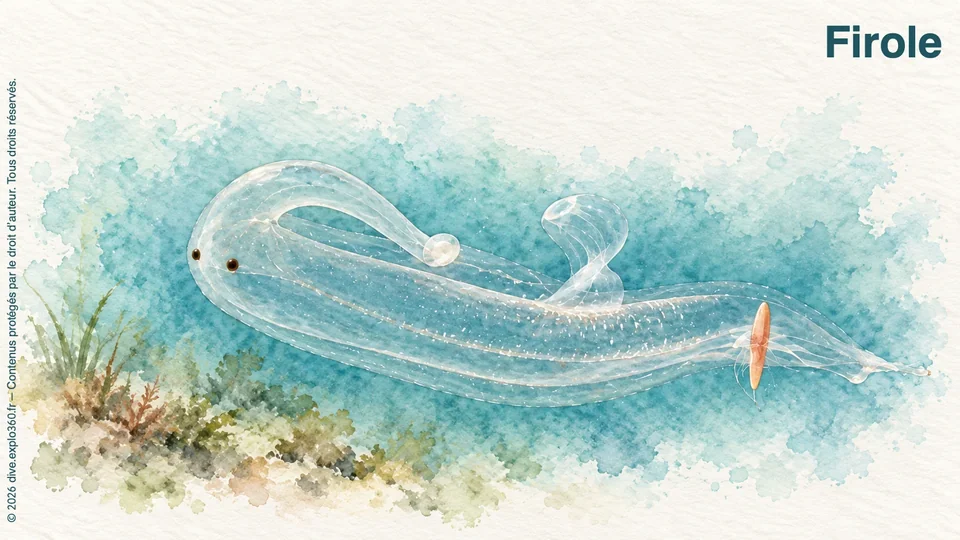
The dark eyes are the clearest features of the sea elephant (Pterotrachea coronata), whose long body seems almost to merge with the water. The head is distinct, and the outline then narrows towards the rear.
No shell covers the adult. Under the body, a ventral fin, a fin on the underside, adds a projection to this transparent form.
WHERE DOES IT LIVE?
It lives exclusively in the pelagic environment, within the water mass, from the surface down to several hundred metres deep. It may sometimes be observed drifting or swimming actively, alone or at low densities, depending on conditions in the water column.
WHAT DOES IT EAT?
The firole hunts fish and other swimming molluscs in open water, including shelled pteropods and heteropods. It can capture relatively large prey. Its mouth contains a radula, a ribbon of hooked teeth used to grip other animals. Unlike gastropods that forage on the seabed, it catches its prey in the water column.
GO FURTHER WITH AMIGANSEAU
Unlock the full profile
Deepen your knowledge with the exclusive chapters and interactive resources included in an AMIGANSEAU licence.
- HOW DOES IT REPRODUCE?
- OUR OBSERVATIONS
- ARTICLE
Also included in the full profile
- Advanced navigation between description, ecological context, observations and behaviour
- Interactive food chain to explore the species’ feeding relationships
- Infographic and illustrated summary profile
 Understand the species