


 Habitat
 Depth
 Group
 Role
 Size
 Good to know
WHAT DOES IT LOOK LIKE?
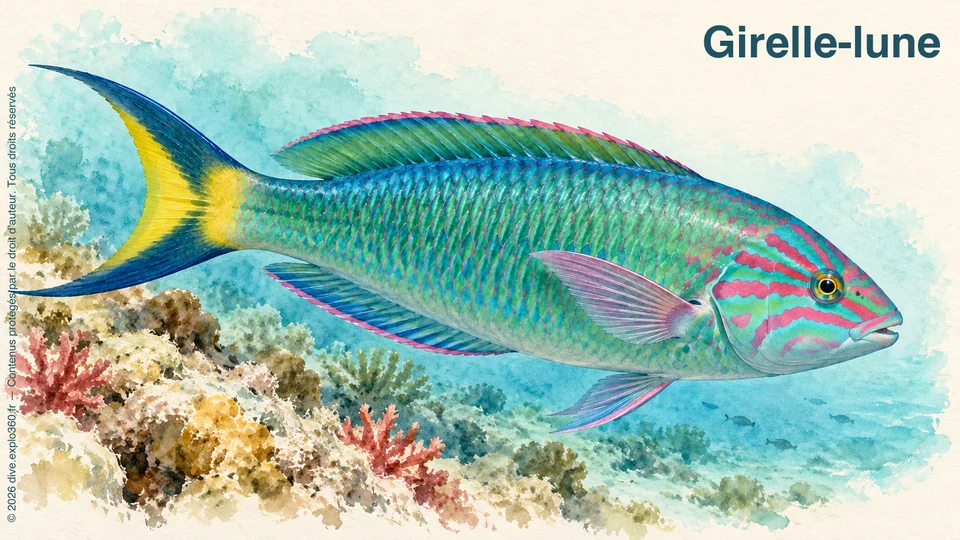
Young moon wrasses (Thalassoma lunare) do not yet show the deeply indented tail of large adults. Dark spots mark their back fin and the area near the tail. Blue to green colouring carries pink patterns on the head and scales. The side fins are pink to violet, blue-edged. Length reaches about 30 cm.
WHERE DOES IT LIVE?
It inhabits lagoons, coastal reefs and rocky areas with many hiding places. It mainly uses shallow water, at depths of 1–30 metres. Young fish stay close to shelters on the seabed. Its range includes the Maldives and the Red Sea, along with many tropical regions of the Indian and Pacific oceans.
WHAT DOES IT EAT?
Small seabed animals are important in the moon wrasse’s diet. It uses molluscs and other invertebrates while also taking small fish. Fish eggs provide another resource. Its menu combines prey of different sizes with available reef egg masses.
GO FURTHER WITH AMIGANSEAU
Unlock the full profile
Deepen your knowledge with the exclusive chapters and interactive resources included in an AMIGANSEAU licence.
- HOW DOES IT REPRODUCE?
- OUR OBSERVATIONS
- ARTICLE
Also included in the full profile
- Advanced navigation between description, ecological context, observations and behaviour
- Interactive food chain to explore the species’ feeding relationships
 Understand the species