Habitat
 Depth
 Group
 Role
 Size
 Good to know
WHAT DOES IT LOOK LIKE?
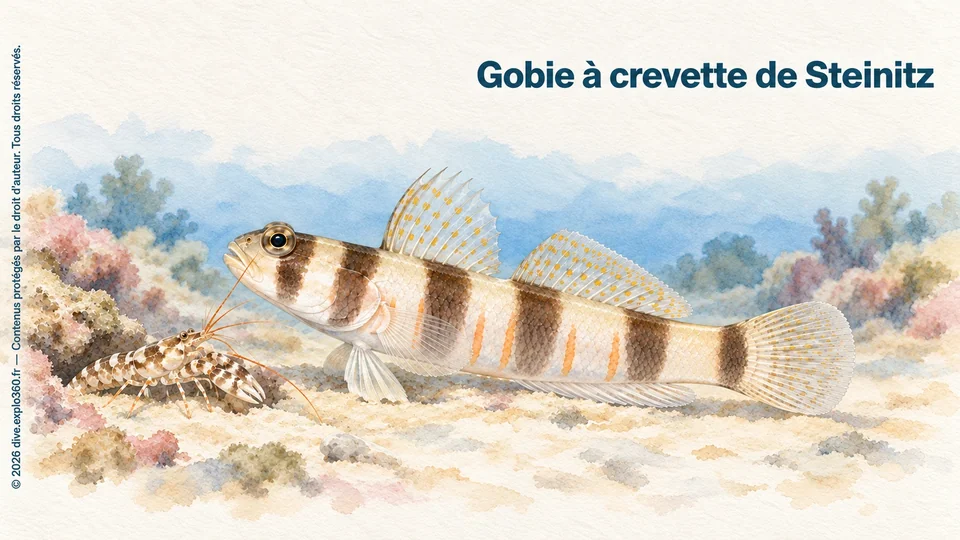
Little yellow spots on the back fins complement the bars of Steinitz’s shrimpgoby (Amblyeleotris steinitzi). Five brown bands cross a pale body, sometimes marked with orange between them. The eyes are high, the tail rounded. Resemblance to other barred gobies makes identification by sight difficult. The 13 cm maximum excludes the tail.
WHERE DOES IT LIVE?
The species occurs in the Red Sea and Indo-Pacific. It uses sandy lagoon and reef-slope bottoms and sometimes estuaries. A depth range of two to forty-three metres is published, with many encounters at moderate depths. An alpheid, or snapping shrimp, maintains the burrow. Sediment structure matters: a shelter in sand provides different opportunities from an existing crack in rock. The burrow forms part of the animal’s habitat.
WHAT DOES IT EAT?
Small invertebrates feed Steinitz’s shrimpgoby. It forages near the seabed, close to its sandy refuge. Little else is known about what it eats in the wild.
GO FURTHER WITH AMIGANSEAU
Unlock the full profile
Deepen your knowledge with the exclusive chapters and interactive resources included in an AMIGANSEAU licence.
- HOW DOES IT REPRODUCE?
- OUR OBSERVATIONS
- ARTICLE
Also included in the full profile
- Advanced navigation between description, ecological context, observations and behaviour
- Interactive food chain to explore the species’ feeding relationships
 Understand the species