


 Habitat
 Depth
 Group
 Role
 Average size
WHAT DOES IT LOOK LIKE?
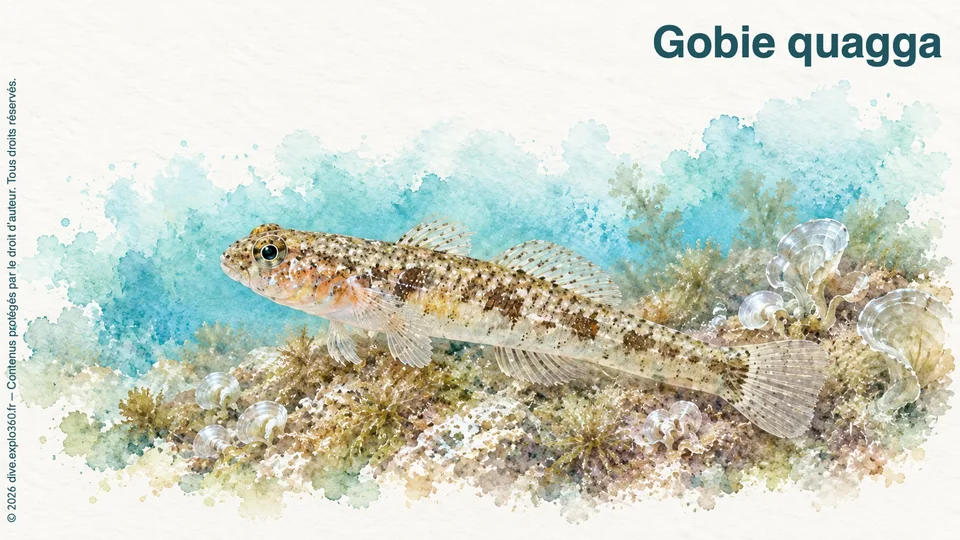
Closely spaced eyes high on the pointed head shape the profile of the quagga goby (Pomatoschistus quagga). The slender body is almost cylindrical and extends into a fairly long narrow section before the tail fin.
Dark streaks on the sides and markings on the back stand out to varying degrees against yellowish grey. A triangular black patch sits at the base of the tail. Pattern intensity varies; its appearance is not fixed in every circumstance.
WHERE DOES IT LIVE?
It frequents shallow coastal areas, mainly on sandy or muddy-sand seabeds, sometimes alongside seagrass meadows. It can be observed from a few metres to several tens of metres deep, depending on local conditions.
It can sometimes be encountered in small groups above the seabed. In danger, it quickly presses itself against the substrate or takes refuge in the sand, where it becomes difficult to spot.
WHAT DOES IT EAT?
Amphipods are among the known prey of the quagga goby. These small crustaceans, along with other animals living on the substrate, form part of its diet. The fish searches for prey close to the bottom, even when making short movements above the sand.
GO FURTHER WITH AMIGANSEAU
Unlock the full profile
Deepen your knowledge with the exclusive chapters and interactive resources included in an AMIGANSEAU licence.
- HOW DOES IT REPRODUCE?
- OUR OBSERVATIONS
- ARTICLE
Also included in the full profile
- Advanced navigation between description, ecological context, observations and behaviour
- Interactive food chain to explore the species’ feeding relationships
- Infographic and illustrated summary profile
 Understand the species