Habitat
 Depth
 Group
 Role
 Average size
WHAT DOES IT LOOK LIKE?
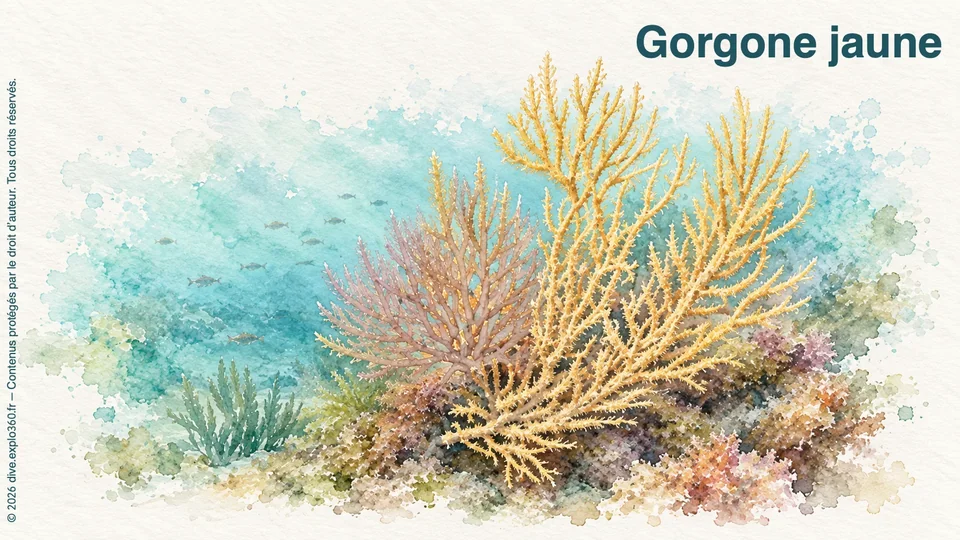
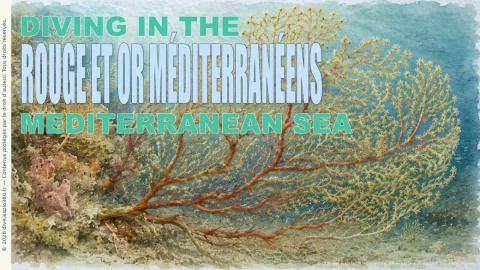
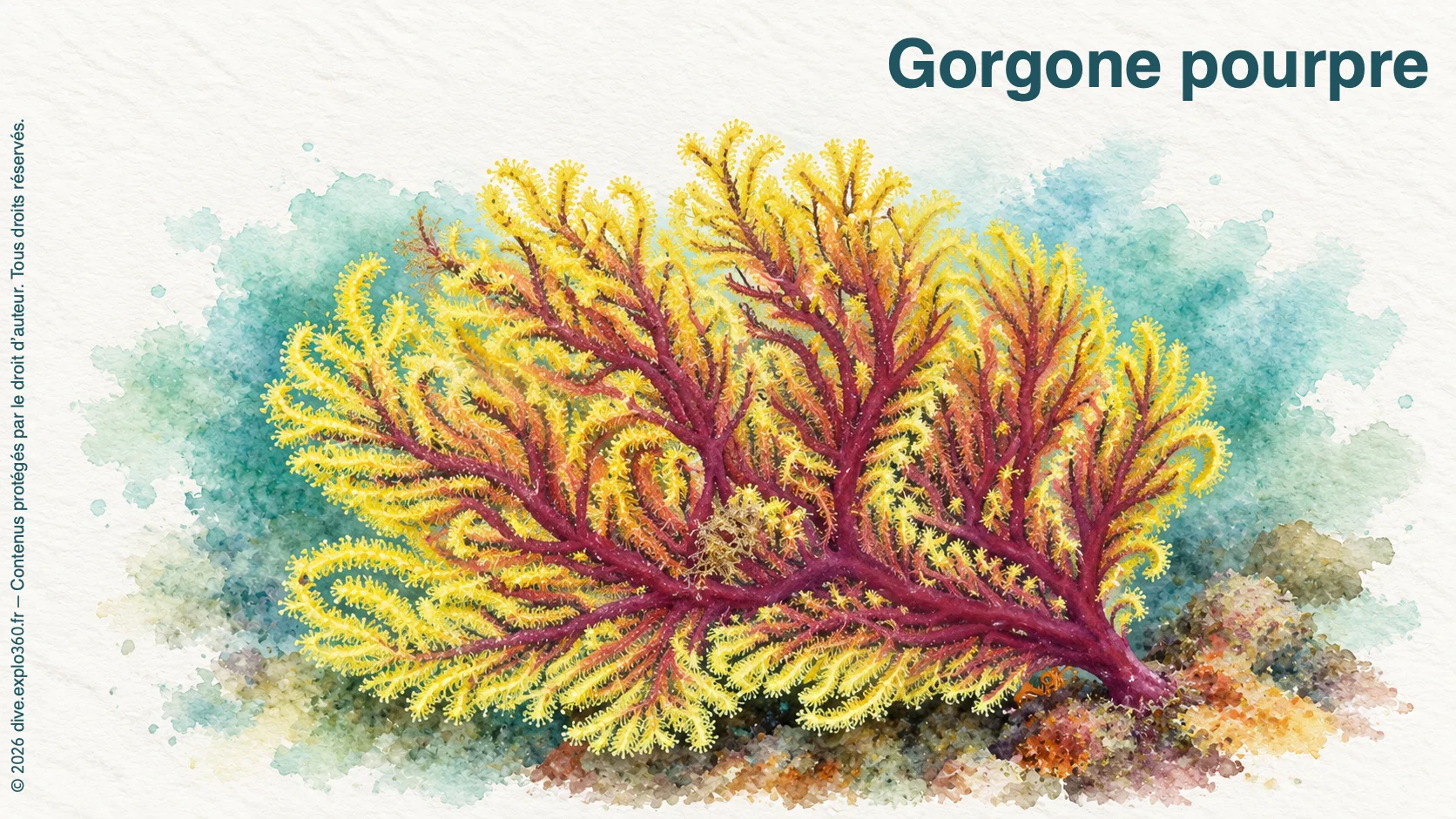
Yellow-orange colouring highlights the short branches of the yellow gorgonian (Eunicella cavolini). Their irregular divisions form a fan generally developed in one plane, without perfect symmetry.
The branches are round in cross-section. They carry the polyps, the small animals living together in the colony, whose details remain hard to see from a distance.
WHERE DOES IT LIVE?
It is encountered on rocky substrates exposed to a steady current, mainly in the Mediterranean. It grows at depths generally ranging from a few tens to a hundred metres, depending on the area.
WHAT DOES IT EAT?
The yellow gorgonian presents its branches to the current, often nearly perpendicular to it. Its polyps collect suspended organic particles, living or dead. Water brings food to the tentacles, so the colony does not need to move in search of it. After capture and digestion, nutrients can be distributed through channels linking the polyps. Behind the fan’s apparent stillness, many tiny animals make catches that contribute to shared nutrition.
GO FURTHER WITH AMIGANSEAU
Unlock the full profile
Deepen your knowledge with the exclusive chapters and interactive resources included in an AMIGANSEAU licence.
- HOW DOES IT REPRODUCE?
- OUR OBSERVATIONS
- ARTICLE
Also included in the full profile
- Advanced navigation between description, ecological context, observations and behaviour
- Interactive food chain to explore the species’ feeding relationships
- Infographic and illustrated summary profile
- Additional photographic observations

 Understand the species