Habitat
 Depth
 Group
 Role
WHAT DOES IT LOOK LIKE?
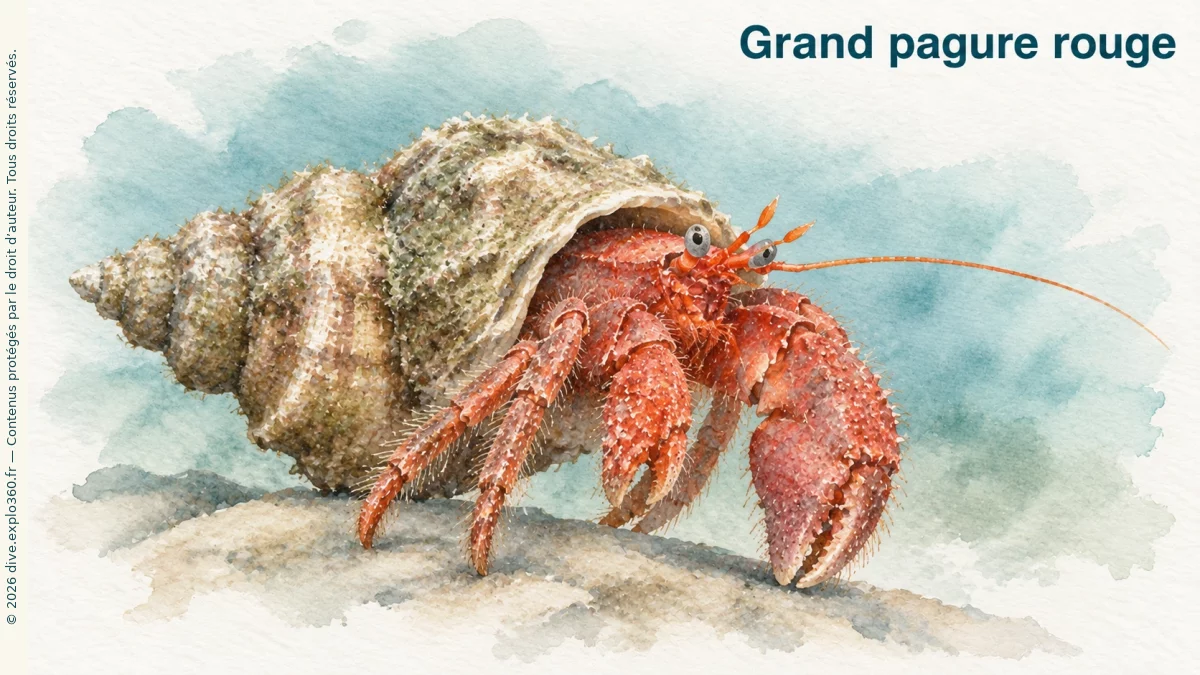
The large red hermit crab measures around ten centimetres including legs and claws. Bright red predominates, with pink shades at the joints and orange-red antennae. The eyes are grey. The left claw is noticeably larger than the right.
The legs and claws have a granular surface with small bumps and hairs. This helps distinguish it from Dardanus arrosor, whose appendages have more regularly arranged ridges, producing a scale-like appearance. The soft abdomen is sheltered in a shell borrowed from a gastropod, a single-shelled mollusc such as a sea snail.
WHERE DOES IT LIVE?
It favours rocky areas, boulders and cavities along small rock faces. Encounters are possible from shallow water to around one hundred metres. By day, part of the body and shell may remain concealed in a hollow.
Activity is often greater at night. The species occurs in the Mediterranean and eastern Atlantic, including areas near the Iberian Peninsula and several archipelagos in this region.
WHAT DOES IT EAT?
It eats organic remains, tending towards animal material. Fish remains can provide food: footage published by the University of Granada shows an individual eating scorpionfish remains.
This illustrates scavenging, feeding on animals that are already dead. Carried anemones may collect some of the scattered fragments.
GO FURTHER WITH AMIGANSEAU
Unlock the full profile
Deepen your knowledge with the exclusive chapters and interactive resources included in an AMIGANSEAU licence.
- HOW DOES IT REPRODUCE?
- OUR OBSERVATIONS
- ARTICLE
Also included in the full profile
- Advanced navigation between description, ecological context, observations and behaviour
- Interactive food chain to explore the species’ feeding relationships