Habitat
 Depth
 Group
 Role
WHAT DOES IT LOOK LIKE?
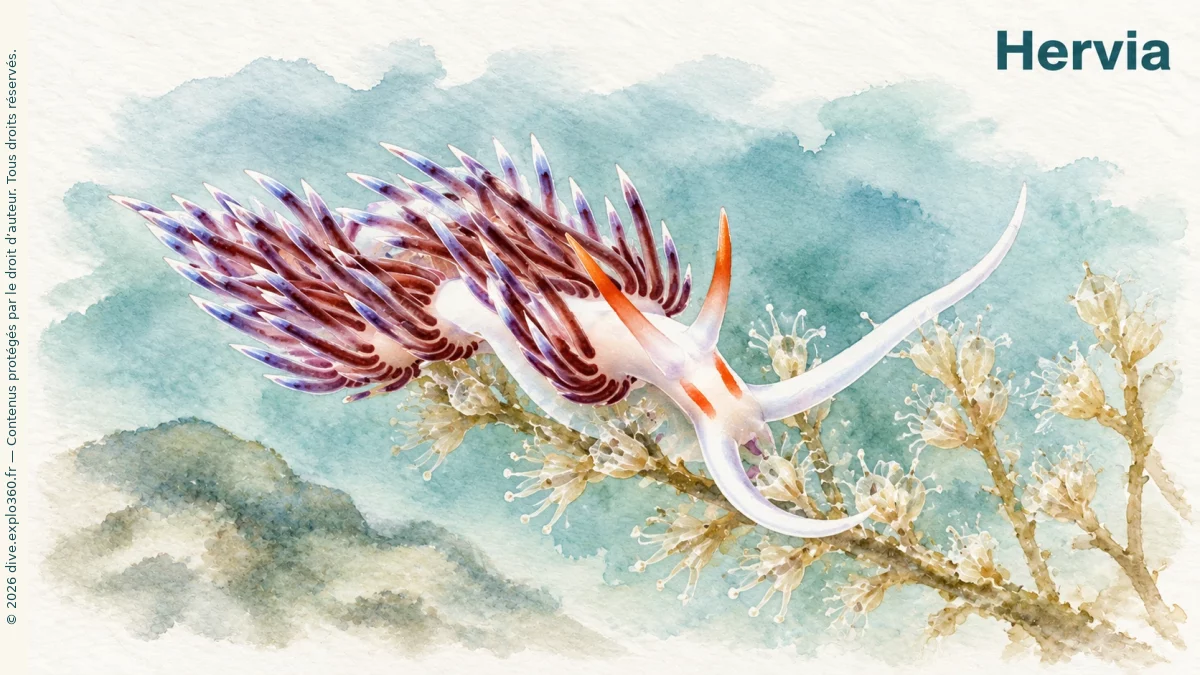
This shell-less slug generally measures around three centimetres, sometimes up to five. Its white body carries many cerata, back projections containing digestive branches, coloured orange, brown or violet with bluish tips.
The head has two long white tentacles and two rhinophores, sensory organs detecting substances in water, with orange upper parts. Two orange marks sit towards the front. The long tapered tail lacks cerata.
WHERE DOES IT LIVE?
It inhabits rocky seabeds, particularly where Eudendrium hydroids grow. These colonial animals form small branches and are not algae.
Encounters are frequent in the warmer season when colonies are available. The slug uses the branches for movement, support and feeding.
WHAT DOES IT EAT?
It eats polyps, the hydroid’s small feeding units, using its radula, a band of teeth in the mouth. It also obtains plankton recently captured by the polyps.
Experiments showed more frequent selection of well-fed polyps. This describes an observed feeding response without attributing intention or reasoning to the slug.
GO FURTHER WITH AMIGANSEAU
Unlock the full profile
Deepen your knowledge with the exclusive chapters and interactive resources included in an AMIGANSEAU licence.
- HOW DOES IT REPRODUCE?
- OUR OBSERVATIONS
- ARTICLE
Also included in the full profile
- Advanced navigation between description, ecological context, observations and behaviour
- Interactive food chain to explore the species’ feeding relationships