


 Habitat
 Depth
 Group
 Role
 Average size
WHAT DOES IT LOOK LIKE?
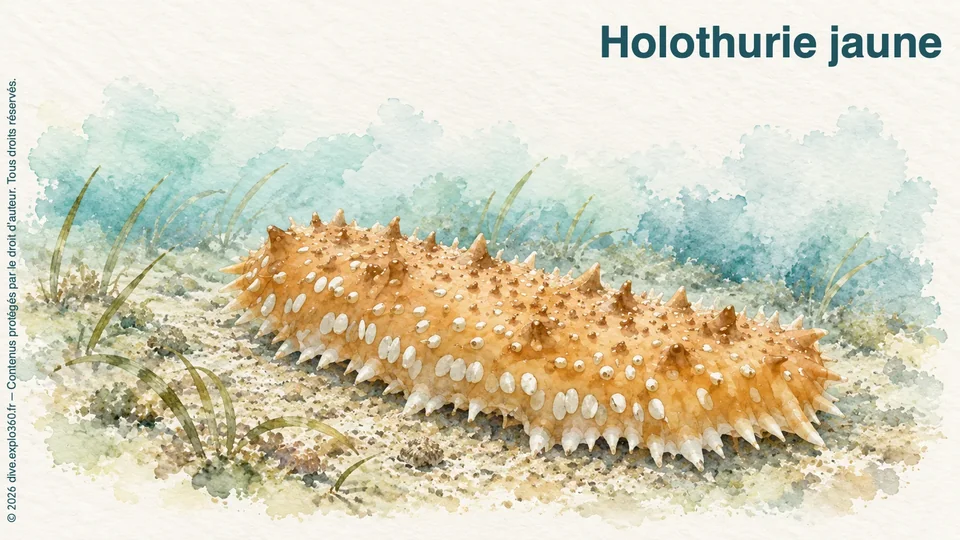
The flat underside and rounded back shape the outline of the royal sea cucumber (Parastichopus regalis). The broad, elongated body looks less cylindrical than that of many sea cucumbers.
Beige colouring is dotted with tubercles, small white bumps. Towards the lower sides they lengthen and become pointed, emphasising the relief of the outline.
WHERE DOES IT LIVE?
It mainly frequents soft sandy or muddy seabeds, sometimes associated with detrital areas rich in organic particles. It is mostly encountered from a few tens to several hundred metres deep, in the Mediterranean and some neighbouring Atlantic areas. It often rests on the sediment surface or partly buries itself.
WHAT DOES IT EAT?
The royal sea cucumber works its mouth tentacles over the sediment surface, collecting the upper layer and bringing it to the mouth. Organic matter supplies food, while indigestible grains pass through the animal and leave through the anus. Particle size matters too: finer grains have been found in its gut than in neighbouring sediment. Feeding combines collection of a surface deposit with selection of the material, rather than feeding on the sand itself.
GO FURTHER WITH AMIGANSEAU
Unlock the full profile
Deepen your knowledge with the exclusive chapters and interactive resources included in an AMIGANSEAU licence.
- HOW DOES IT REPRODUCE?
- OUR OBSERVATIONS
- ARTICLE
Also included in the full profile
- Advanced navigation between description, ecological context, observations and behaviour
- Interactive food chain to explore the species’ feeding relationships
- Infographic and illustrated summary profile
 Understand the species