


 Habitat
 Depth
 Group
 Role
 Size
 Good to know
WHAT DOES IT LOOK LIKE?
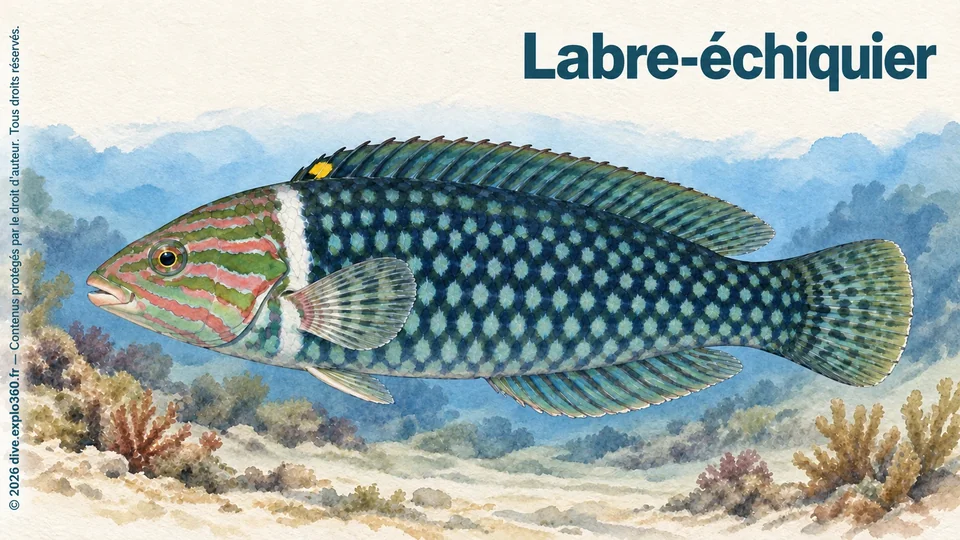
The checkerboard wrasse (« Halichoeres hortulanus ») has a slender body and can reach 27 cm. Dark markings along the scales produce a checked pattern that varies across its range. Pink lines cross the head, and one or two yellow patches appear near the dorsal fin. Red Sea adults may be dark blue-green. Juveniles look strikingly different, with black-and-white markings and a dark, yellow-rimmed eyespot on the dorsal fin.
WHERE DOES IT LIVE?
Look for this wrasse around coral reefs, especially where reef structures meet sandy patches. It moves close to the bottom and can bury itself in sand at night. The species ranges across the Red Sea and much of the Indo-Pacific. Most descriptions place it within the upper 30 metres, although deeper records also exist.
WHAT DOES IT EAT?
The checkerboard wrasse hunts molluscs, crustaceans and sea urchins near the seabed. Its strong jaws can crush shells and hard outer coverings. It may also turn over small pieces of coral rubble to reach animals sheltering underneath, a behaviour divers can watch without disturbing the fish.
GO FURTHER WITH AMIGANSEAU
Unlock the full profile
Deepen your knowledge with the exclusive chapters and interactive resources included in an AMIGANSEAU licence.
- HOW DOES IT REPRODUCE?
- OUR OBSERVATIONS
- ARTICLE
Also included in the full profile
- Advanced navigation between description, ecological context, observations and behaviour
- Interactive food chain to explore the species’ feeding relationships
 Understand the species

