Habitat
 Depth
 Group
 Role
WHAT DOES IT LOOK LIKE?
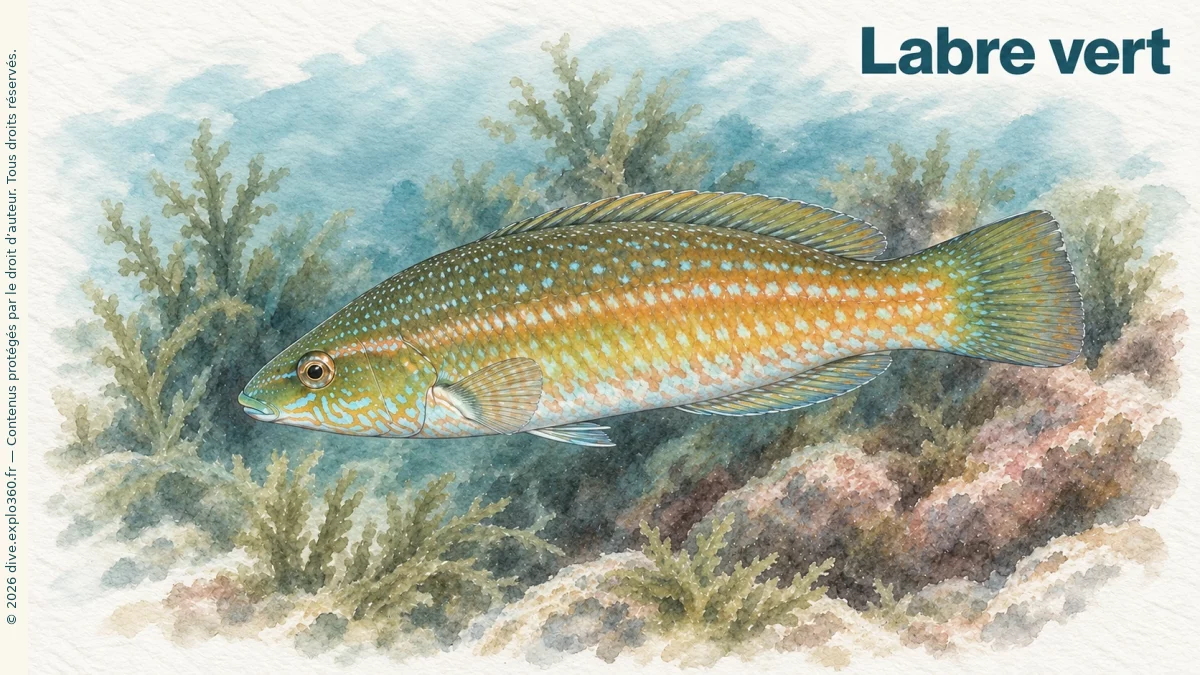
Green wrasse have elongated bodies, long heads and pointed snouts. Their mouths are fairly large, with thick lips. Common sizes range from 15 to 35 centimetres, with large individuals reaching about 50 centimetres.
Young fish in seagrass beds are often bright green with a pale stripe along the side. As they grow, they may become more yellowish, brown or reddish; some adults show small white spots.
The similar-looking brown wrasse has a shorter head and heavier body. The green wrasse’s long snout is therefore a better clue than colour alone.
WHERE DOES IT LIVE?
The species occurs on rocky bottoms and in seagrass beds, from a few metres down to around fifty metres. Young fish particularly frequent seagrass.
Often alone, a fish moves between shelters and may disappear beneath a rock or among leaves. Its speed makes observation difficult if it is followed too closely.
WHAT DOES IT EAT?
Strong teeth allow green wrasse to catch and crush prey protected by shells or hard outer coverings. Molluscs and crustaceans are among their food.
They also eat echinoderms, animals such as sea urchins, and fish. Seagrass provides a habitat rather than a meal.
GO FURTHER WITH AMIGANSEAU
Unlock the full profile
Deepen your knowledge with the exclusive chapters and interactive resources included in an AMIGANSEAU licence.
- HOW DOES IT REPRODUCE?
- OUR OBSERVATIONS
- ARTICLE
Also included in the full profile
- Advanced navigation between description, ecological context, observations and behaviour
- Interactive food chain to explore the species’ feeding relationships