Habitat
 Depth
 Group
 Role
WHAT DOES IT LOOK LIKE?
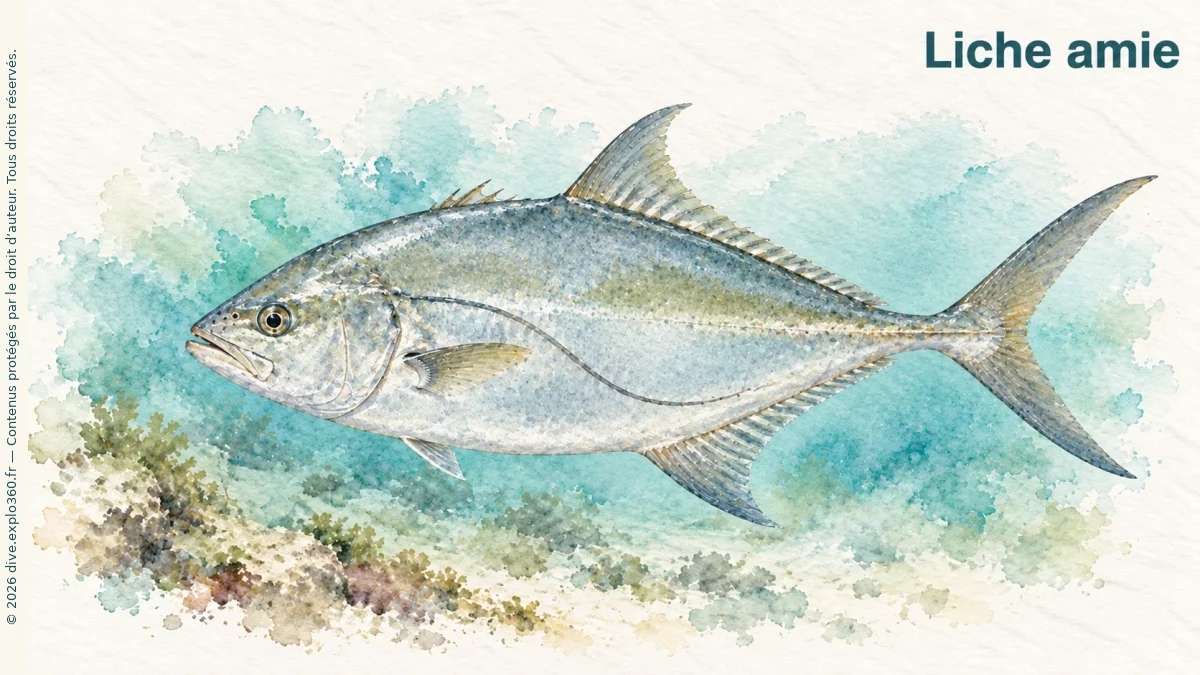
The leerfish has a deep compressed body, silver sides, greyish back and white concave underside. The pointed head is relatively small, with a large mouth extending behind the eye. Short spines form the reduced first dorsal. Tall leading portions characterise the second dorsal and anal, and the tail is strongly forked. The lateral line drops sharply behind the pectoral before rising towards the tail.
WHERE DOES IT LIVE?
Life is mainly coastal pelagic. Nearshore and estuarine waters, including turbid areas, are documented. DORIS gives the surface to around fifty metres and a range covering the Mediterranean, eastern Atlantic and part of the western Indian Ocean. Restricting the fish to clear-water imagery would be misleading. Sightings vary with area, movement and conditions.
WHAT DOES IT EAT?
Adults predominantly eat fish, notably mullets and other coastal resources. Juveniles use a broader diet, including crustaceans and molluscs. Growth therefore changes resource use. This does not justify listing every coastal fish as prey: specific relationships require their own evidence.
GO FURTHER WITH AMIGANSEAU
Unlock the full profile
Deepen your knowledge with the exclusive chapters and interactive resources included in an AMIGANSEAU licence.
- HOW DOES IT REPRODUCE?
- OUR OBSERVATIONS
- ARTICLE
Also included in the full profile
- Advanced navigation between description, ecological context, observations and behaviour
- Interactive food chain to explore the species’ feeding relationships