Habitat
 Depth
 Group
 Role
WHAT DOES IT LOOK LIKE?
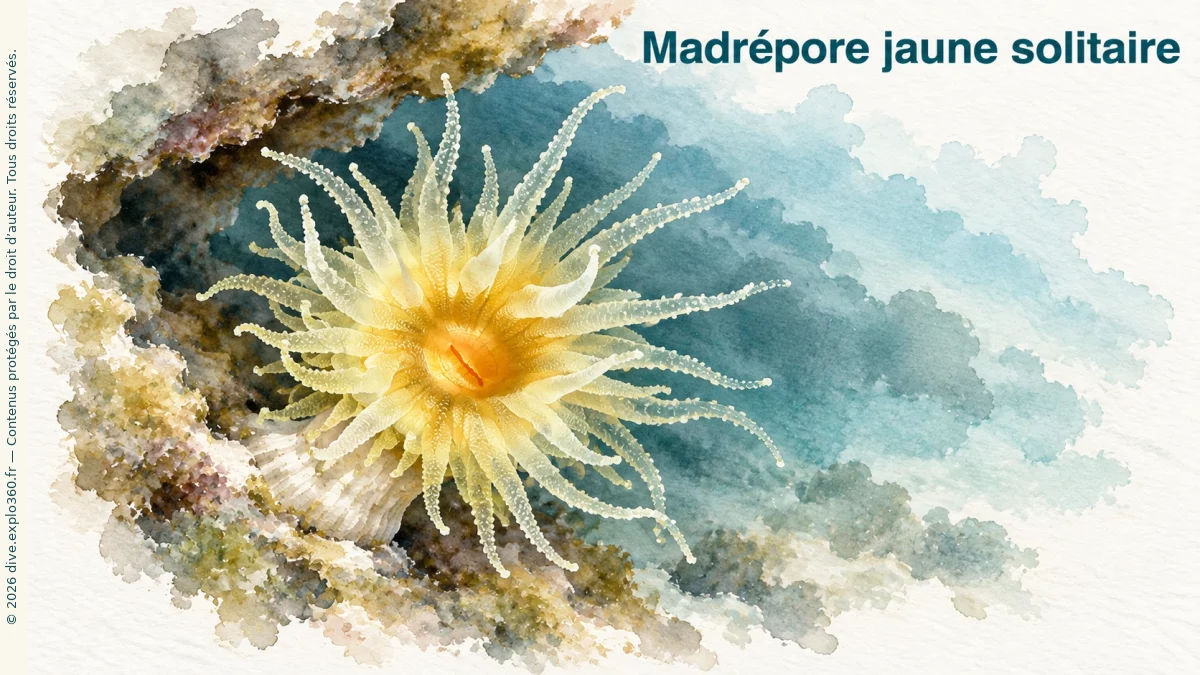
The living part is a bright yellow polyp, a small animal with a mouth surrounded by many tentacles. It can retract into its calcareous skeleton attached to rock. The cup is generally narrower at the base than the top.
Skeletal diameter can reach around seventeen millimetres; the open polyp may spread to about three centimetres. Distinguish mineral structure dimensions from those of the expanded animal. Colour can sometimes shade towards orange on the oral disc, the surface surrounding the mouth.
WHERE DOES IT LIVE?
It occupies shaded rocks beneath overhangs and along cave-entrance walls. Encounters are often at a few tens of metres, but dark shelter can hold it much shallower. Its range also includes Atlantic coasts and the southern British Isles.
Several animals can be crowded on one rock face. “Solitary” describes the usual organisation as independent polyps, not a required distance between neighbours. Distinguish it from a carpet of small interconnected yellow animals.
WHAT DOES IT EAT?
Tentacles catch waterborne prey, including small crustaceans. Stinging cells help immobilise them and food is directed towards the mouth.
The species lacks the photosynthetic algae supplying some resources to other corals. Catching food remains necessary in its shaded habitat.
GO FURTHER WITH AMIGANSEAU
Unlock the full profile
Deepen your knowledge with the exclusive chapters and interactive resources included in an AMIGANSEAU licence.
- HOW DOES IT REPRODUCE?
- OUR OBSERVATIONS
- ARTICLE
Also included in the full profile
- Advanced navigation between description, ecological context, observations and behaviour
- Interactive food chain to explore the species’ feeding relationships