


 Habitat
 Depth
 Group
 Role
 Average size
WHAT DOES IT LOOK LIKE?
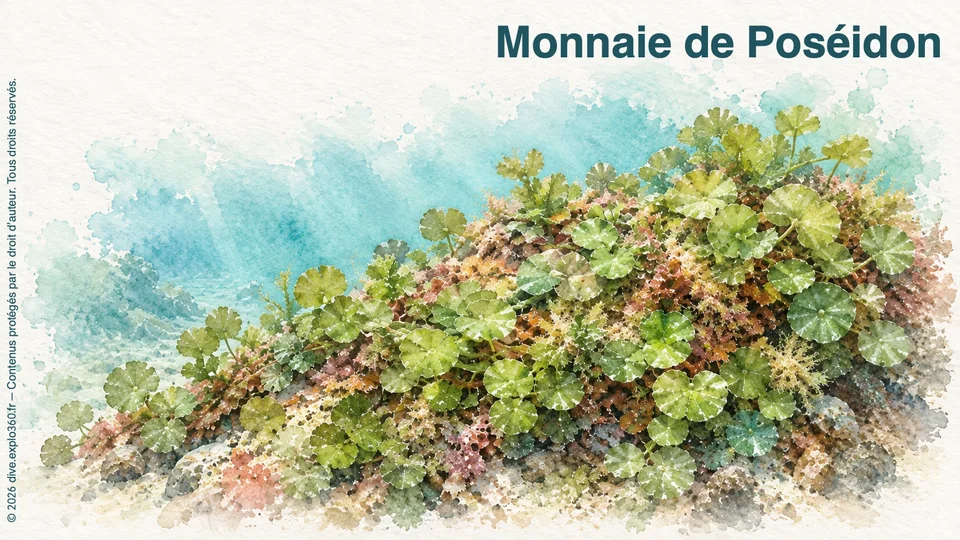
The “coins” of sea cactus (Halimeda tuna) flatten into discs or little paddles. They overlap and branch in one plane, joined by narrower areas.
Their colour is green, sometimes pale. Calcification, the deposition of calcareous mineral material within the segments, gives them stiffness and emphasises their appearance as separate little elements.
WHERE DOES IT LIVE?
Sea cactus attaches to rock and other firm surfaces, particularly shaded areas on steep underwater walls and in coralligenous habitats. It can persist where light levels are relatively low.
Records extend to roughly 75 metres, although the depth range differs between sites.
WHAT DOES IT EAT?
Its green tissues carry out photosynthesis, using sunlight to produce organic material from carbon dissolved in seawater. Mineral nutrients come from the surrounding water. Calcium carbonate deposited within the segments gives them much of their stiffness.
GO FURTHER WITH AMIGANSEAU
Unlock the full profile
Deepen your knowledge with the exclusive chapters and interactive resources included in an AMIGANSEAU licence.
- HOW DOES IT REPRODUCE?
- OUR OBSERVATIONS
- ARTICLE
Also included in the full profile
- Advanced navigation between description, ecological context, observations and behaviour
- Interactive food chain to explore the species’ feeding relationships
- Infographic and illustrated summary profile
 Understand the species