Habitat
 Depth
 Group
 Role
WHAT DOES IT LOOK LIKE?
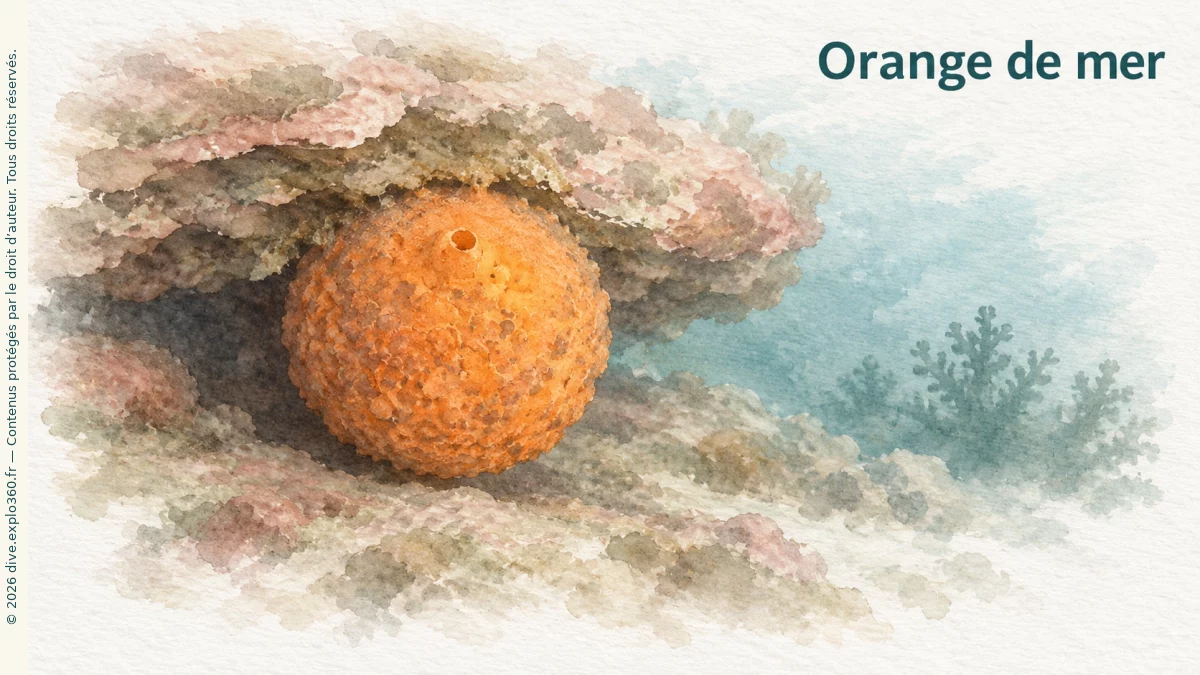
The Mediterranean sea orange forms an orange, sometimes reddish-orange ball a few centimetres across. Rounded projections mark its bumpy surface. An osculum, the opening through which water leaves, lies at the top, opposite the attachment point.
During budding, small rounded masses develop on short stalks. The skeleton consists of spicules, tiny mineral elements whose shape and arrangement help refine identification.
WHERE DOES IT LIVE?
It attaches to Mediterranean rocks, notably beneath overhangs and in shaded cave areas. French records include both the mainland and Corsica.
Its ball shape can conceal the attachment point when viewed from above. A side view helps explain its position without trying to lift it.
WHAT DOES IT EAT?
It feeds by filtering microscopic particles from water. Water enters through numerous pores, circulates inside the body and leaves through the osculum.
Choanocytes, cells with a collar and a moving filament, help drive the flow and capture food. A sponge need not show visible body movement to be active.
GO FURTHER WITH AMIGANSEAU
Unlock the full profile
Deepen your knowledge with the exclusive chapters and interactive resources included in an AMIGANSEAU licence.
- HOW DOES IT REPRODUCE?
- OUR OBSERVATIONS
- ARTICLE
Also included in the full profile
- Advanced navigation between description, ecological context, observations and behaviour
- Interactive food chain to explore the species’ feeding relationships