Habitat
 Depth
 Group
 Role
WHAT DOES IT LOOK LIKE?
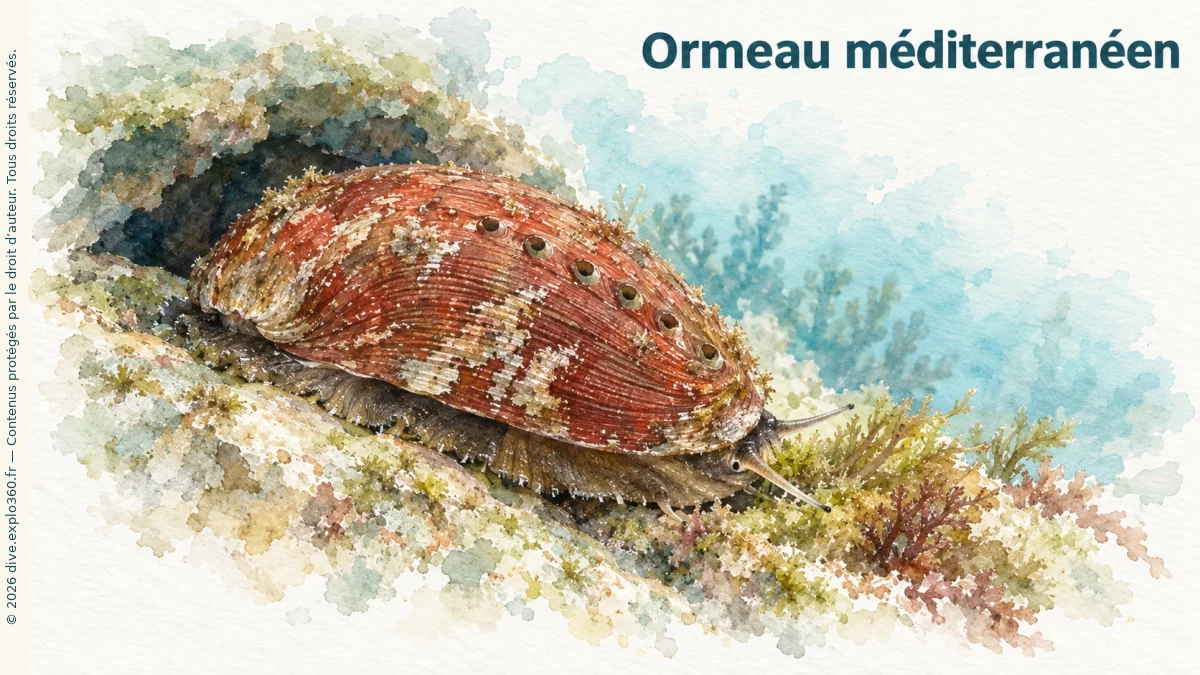
Its single shell is low, elongated and ear-shaped. Six to eight centimetres is commonly given for the Mediterranean form. The surface has folds and variable colours, often hidden by algae or attached organisms.
A row of holes crosses the top; only the newest remain open. The broad muscular foot projects beneath the shell. Sensory tentacles fringe the body, and the head has two eyes visible when the animal emerges.
WHERE DOES IT LIVE?
It uses hard surfaces, the undersides of stones and crevices. It also occurs on submerged walls and piles. During daylight it generally remains hidden.
The name Haliotis tuberculata lamellosa still appears in some Mediterranean accounts. WoRMS treats it as a synonym of Haliotis tuberculata, so the catalogue name matches the currently accepted name.
WHAT DOES IT EAT?
It grazes algae with its radula, a band carrying many microscopic teeth that rasp food. Young animals begin with tiny algae and algal coatings.
Larger individuals use red, brown or green algae. The diet therefore broadens with growth, reflecting resources accessible on seabed surfaces.
GO FURTHER WITH AMIGANSEAU
Unlock the full profile
Deepen your knowledge with the exclusive chapters and interactive resources included in an AMIGANSEAU licence.
- HOW DOES IT REPRODUCE?
- OUR OBSERVATIONS
- ARTICLE
Also included in the full profile
- Advanced navigation between description, ecological context, observations and behaviour
- Interactive food chain to explore the species’ feeding relationships