Habitat
 Depth
 Group
 Role
WHAT DOES IT LOOK LIKE?
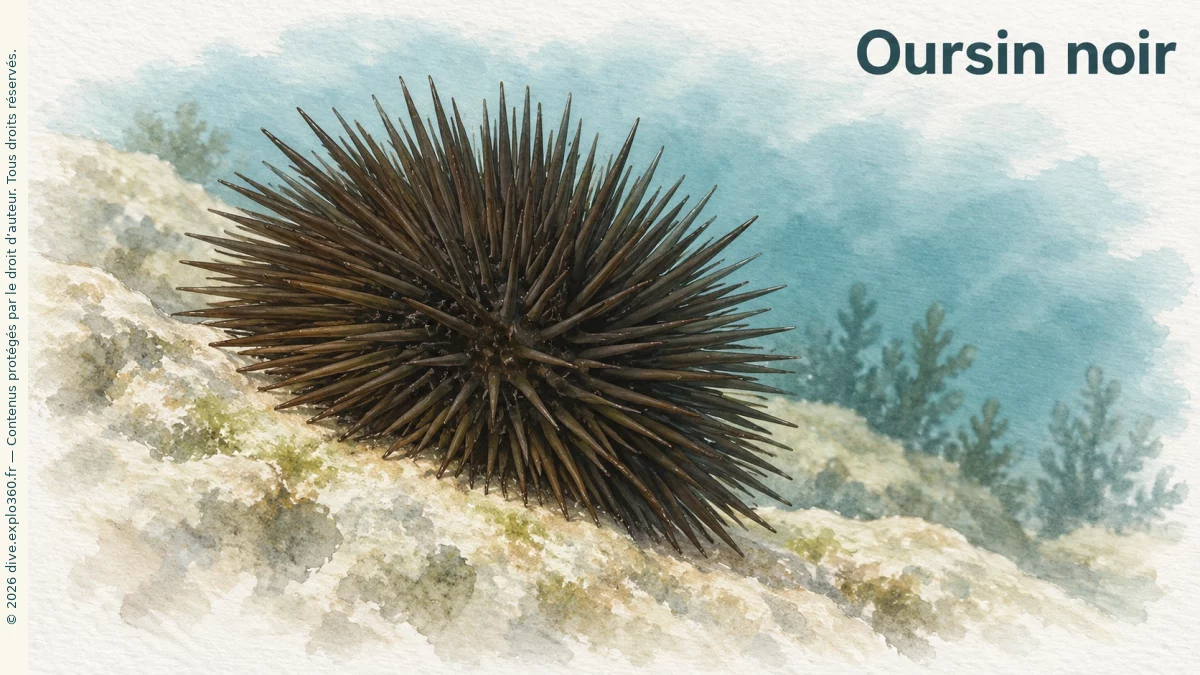
The black sea urchin bears crowded, pointed spines ranging from very dark brown to purplish black. Its test, the rigid covering of calcium carbonate plates, is rounded above and flattened on the oral side, the surface bearing the mouth. A broad spine-free membrane surrounds the mouth.
Tube feet, small extendable tubes, provide attachment to the surface among other functions. Juveniles are browner and less densely spined. Features of a very black adult should therefore not be applied uncritically to small individuals.
WHERE DOES IT LIVE?
It occupies Mediterranean rocky seabeds, often in shallow water, on horizontal or vertical surfaces. It can be conspicuous by day on French coastal walls.
The living cover and rock relief contribute to conditions. Describing them helps compare populations rather than treating every shallow rocky seabed as a uniform habitat.
WHAT DOES IT EAT?
The five teeth of Aristotle’s lantern, its chewing apparatus, scrape surfaces and collect varied resources. The diet includes algae and attached invertebrates, notably small crustaceans and colonial organisms.
Analyses at several sites showed a stronger contribution from animal resources than in the purple sea urchin. Omnivore is a better description than strict herbivore.
GO FURTHER WITH AMIGANSEAU
Unlock the full profile
Deepen your knowledge with the exclusive chapters and interactive resources included in an AMIGANSEAU licence.
- HOW DOES IT REPRODUCE?
- OUR OBSERVATIONS
- ARTICLE
Also included in the full profile
- Advanced navigation between description, ecological context, observations and behaviour
- Interactive food chain to explore the species’ feeding relationships