Habitat
 Depth
 Group
 Role
WHAT DOES IT LOOK LIKE?
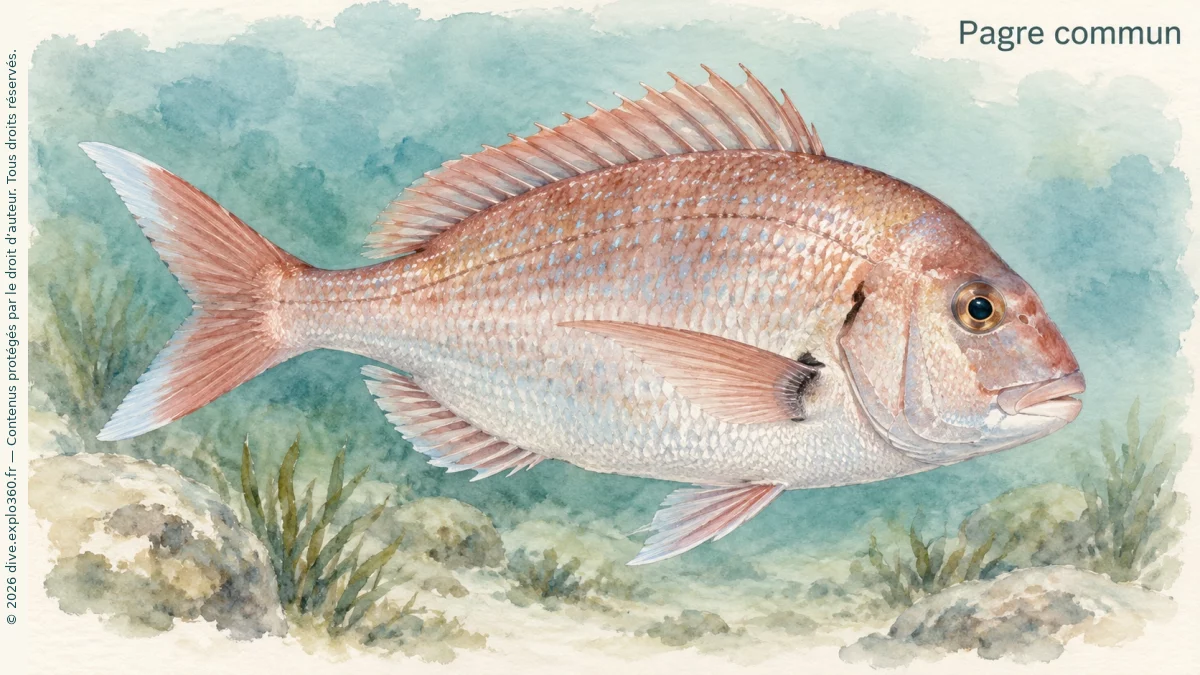
The red porgy is a deep-bodied, compressed seabream, silvery with pink tones. Its convex forehead slopes towards a short, fairly rounded snout. Each lobe of the dark pink tail ends in a white to bluish mark, important when comparing it with the common pandora. A dark area may be visible at the pectoral base. Fish seen on dives are often 15–40 centimetres long, smaller than the largest known individuals.
WHERE DOES IT LIVE?
It inhabits sandy and rocky seabeds, algal growth and areas beside walls. Juveniles find suitable settings near coastal seagrass. Large fish more often remain in deeper areas; seasonal movement may also bring some individuals nearer shore during warm periods. Its natural range includes the Mediterranean, Black Sea and parts of both Atlantic coasts. At a particular site, depth and developmental stage should therefore be considered together.
WHAT DOES IT EAT?
Food chiefly includes crustaceans and molluscs, with bivalves and cephalopods among recorded resources. Jaws carry large anterior canine-like teeth and smaller teeth farther back. This arrangement permits grasping and processing prey offering different kinds of resistance. Fish may also be caught, but portraying the red porgy solely as a fish hunter would omit much of its connection with benthic communities.
GO FURTHER WITH AMIGANSEAU
Unlock the full profile
Deepen your knowledge with the exclusive chapters and interactive resources included in an AMIGANSEAU licence.
- HOW DOES IT REPRODUCE?
- OUR OBSERVATIONS
- ARTICLE
Also included in the full profile
- Advanced navigation between description, ecological context, observations and behaviour
- Interactive food chain to explore the species’ feeding relationships