DIVE.EXPLO360.FRObserve, understand, share
Diver services

You can also access AMIGANSEAU diver services. Sign in to these services with your email address and pairing code.

trouve-MOIIdentify an encounterExplorariumKeep and share your dive memories
ShopAMIGANSEAU ACCESS ↗
Partners and information

Contact us

Verification code

Common stingray

Distribution : Mediterranean and eastern Atlantic, on soft coastal bottoms and in some estuaries.

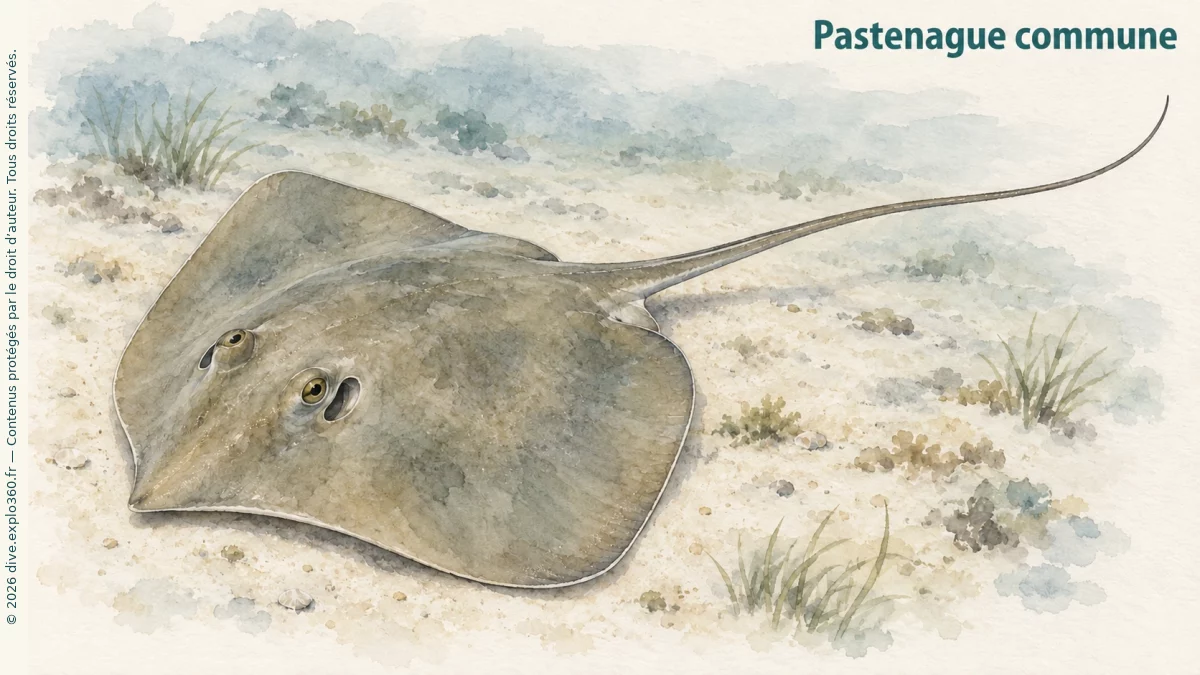
A slight movement of sediment followed by two raised eyes may reveal a common stingray. Concealment and activity are closely linked: the same soft seabed provides cover, a surface for travelling and a place to find prey.

Habitat of Common stingray Habitat
Sand, Detrital bottom
Depth range of Common stingray Depth
0-100 m
Biological group of Common stingray Group
Ecological role of Common stingray Role
Predator

📏 Size

Up to 2.50 m total length including the tail, according to DORIS

⚠️ Precautions

The tail carries a defensive venomous sting. Watch from a distance without touching, surrounding or chasing the ray.

WHAT DOES IT LOOK LIKE?

The common stingray has a diamond-shaped disc with flexible margins and a pointed snout. The usually grey to brown upper surface lacks the large tubercles found in some other stingrays. Its underside is pale. The extended tail carries a serrated sting without a dorsal or caudal fin. Broad pectoral fins propel the animal by undulating; the tail is not its main source of thrust.

WHERE DOES IT LIVE?

The range includes the Mediterranean and eastern Atlantic. Coastal sand, sandy mud and some sheltered estuaries provide habitat. It is often found between 5 and 60 m and can also live at greater depths. These summaries do not predict a sighting at every depth. Local substrate, shelter and conditions matter alongside a maximum depth figure.

WHAT DOES IT EAT?

Its prey includes benthic crustaceans such as crabs and shrimps, together with small fish; worms may also be consumed. The ventral mouth works close to the substrate, and the jaws process prey that may have a hard covering. The disc can help restrain an animal against the bottom.

GO FURTHER WITH AMIGANSEAU

Unlock the full profile

Deepen your knowledge with the exclusive chapters and interactive resources included in an AMIGANSEAU licence.

Choose my licence
  • HOW DOES IT REPRODUCE?
  • OUR OBSERVATIONS
  • ARTICLE

Also included in the full profile

  • Advanced navigation between description, ecological context, observations and behaviour
  • Interactive food chain to explore the species’ feeding relationships
An active licence gives access to enriched profiles and AMIGANSEAU exploration tools.
Common stingray

🧠 Understand the species

What is this species’ ecological role?

AMIGANSEAU Explorer Premium

Access enriched species profiles with advanced content (audio, infographics and detailed articles).

Explore all species easily through a single interface.

Enjoy a smooth, fast learning experience suited to every level.

🔒 The full profile is available with a paid subscription only.

Discover licences

POURSUIVRE L’EXPLORATION

Explore further

ArticleTHE SECRETS OF SANDRead the article →JourneysJourney into maerl and sandDiscover → →ArticleMarine Life, a World of RolesRead the article →