Habitat
 Depth
 Group
 Role
WHAT DOES IT LOOK LIKE?
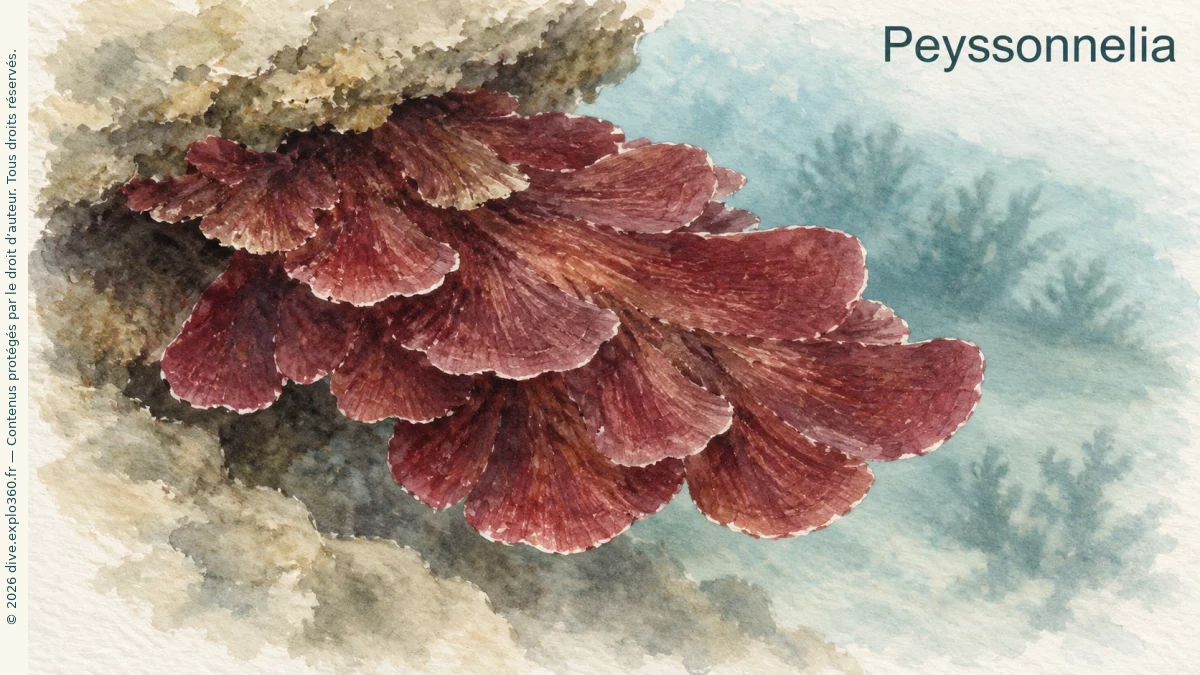
The peyssonnelia has thin red to reddish-orange fans with rounded or lobed margins. Paler concentric and radial lines may mark the surface. The thallus, the algal body, remains close to its support.
Rhizoids, fine underside filaments, provide attachment. Neighbouring blades can partly overlap without forming one surface fused to rock.
WHERE DOES IT LIVE?
It inhabits shaded, relatively calm French Mediterranean sites: overhangs, cracks and sheltered surfaces. Associations with calcifying algae and Posidonia rhizomes, the creeping stems, are also described.
Record orientation and shelter.
WHAT DOES IT EAT?
Photosynthesis produces organic matter using light energy and available carbon. Red-algal pigments contribute to light capture. Mineral nutrients are absorbed from water.
Nutrition does not depend on attachment filaments extracting food from rock. Support, absorption and production are distinct functions.
GO FURTHER WITH AMIGANSEAU
Unlock the full profile
Deepen your knowledge with the exclusive chapters and interactive resources included in an AMIGANSEAU licence.
- HOW DOES IT REPRODUCE?
- OUR OBSERVATIONS
- ARTICLE
Also included in the full profile
- Advanced navigation between description, ecological context, observations and behaviour
- Interactive food chain to explore the species’ feeding relationships