Habitat
 Depth
 Group
 Role
WHAT DOES IT LOOK LIKE?
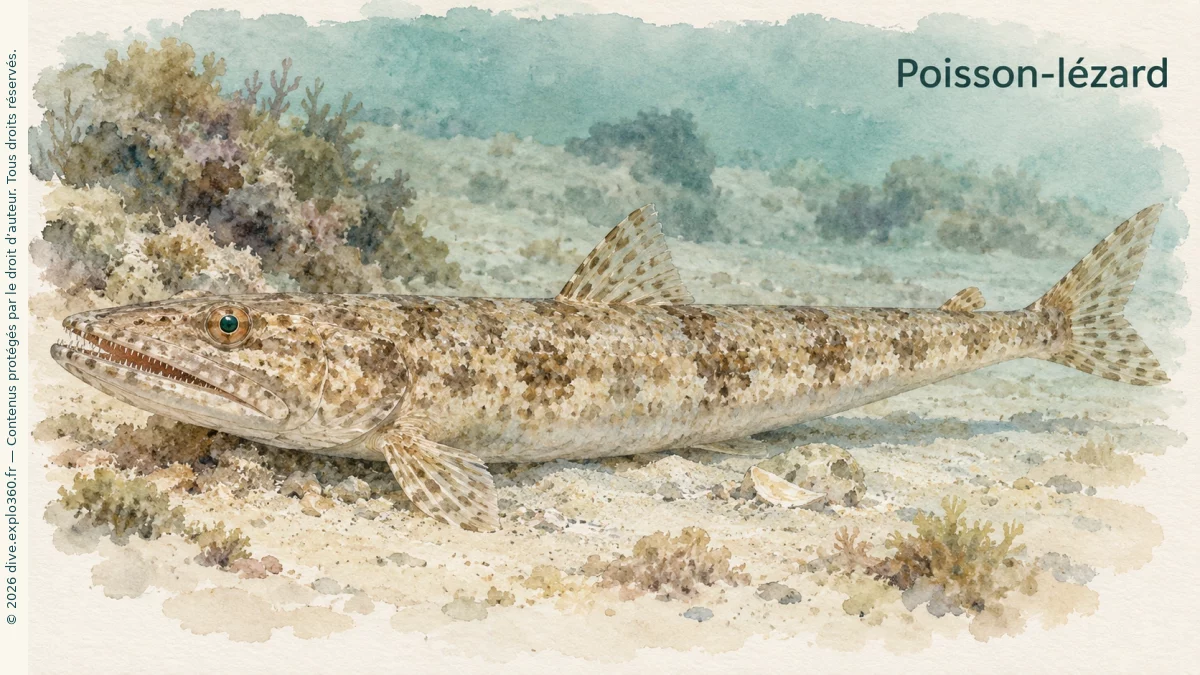
The Atlantic lizardfish combines a flattened head with an elongated, almost cylindrical body. Seen from above, the head forms a triangle. The very long mouth extends behind the eyes and contains numerous slender teeth. High-set eyes may show green reflections surrounded by orange tones.
Body colour ranges from pale beige to darker shades. Bluish or whitish lines run along the sides, while dorsal markings may extend into bands. The triangular dorsal and the small adipose fin farther back provide useful characters. Ordinary lengths given by the sources are around 20–40 centimetres.
WHERE DOES IT LIVE?
Sand is the usual observation habitat, both in shallow water and at greater depths. It is often seen in the first few tens of metres and can also live down to 400 metres. A maximum depth does not describe a constant preference.
The species is recorded in the Mediterranean, including Côte Bleue and the coastline between Marseille and the French Riviera. Its natural range also includes subtropical regions on both sides of the Atlantic. At a site, it may rest openly or expose only a small part of its body above the sediment.
WHAT DOES IT EAT?
The Atlantic lizardfish is chiefly piscivorous. Crustaceans and cephalopods are also among reported resources. Stillness, partial burial and a pattern resembling the seabed contribute to an indirect approach: prey may pass close to a predator it has not detected.
Capture then depends on rapid acceleration. The fish can leave the bottom to seize a target in the water before returning to the substrate. A sudden movement seen by a diver is not automatically an attack, however: approaching too closely may also trigger escape to another position.
GO FURTHER WITH AMIGANSEAU
Unlock the full profile
Deepen your knowledge with the exclusive chapters and interactive resources included in an AMIGANSEAU licence.
- HOW DOES IT REPRODUCE?
- OUR OBSERVATIONS
- ARTICLE
Also included in the full profile
- Advanced navigation between description, ecological context, observations and behaviour
- Interactive food chain to explore the species’ feeding relationships