Habitat
 Depth
 Group
 Role
WHAT DOES IT LOOK LIKE?
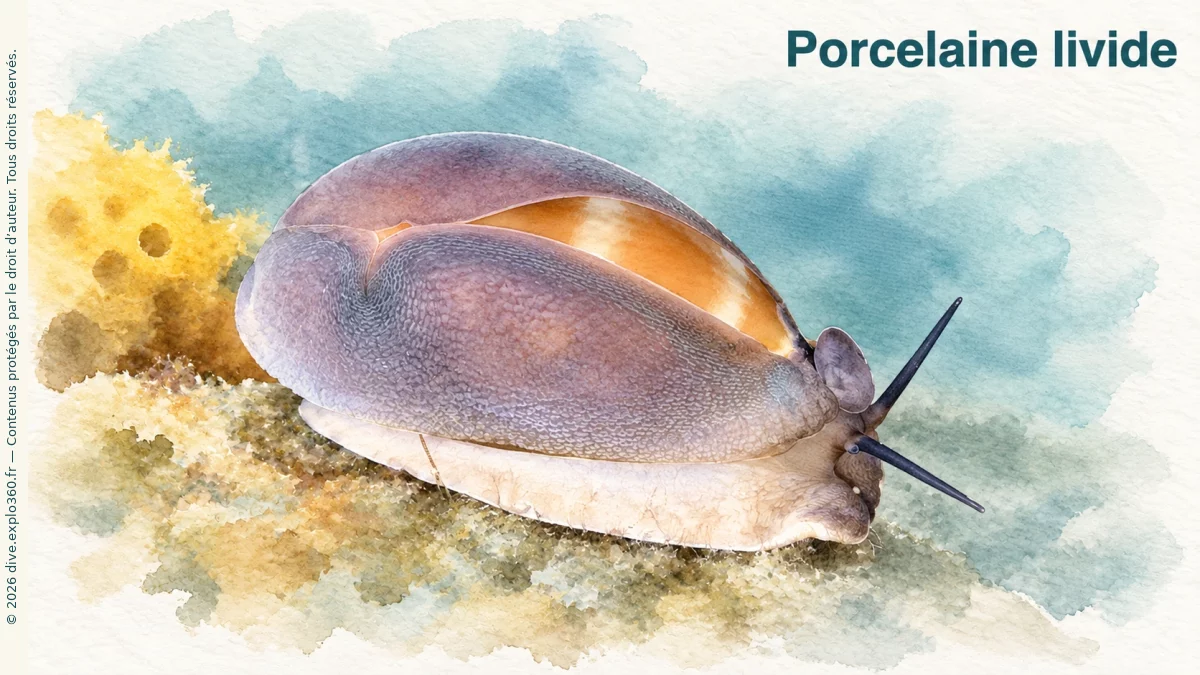
Its smooth oval shell is brown to grey-brown with two paler crosswise bands. Orange ends carry dark spots. It can exceed six and a half centimetres. The narrow opening underneath is bordered by small tooth-like ridges.
The mantle, a living body tissue, spreads in two lobes that can meet over the shell. The final whorl hides earlier coiling, unlike the clearly visible spiral of other snails.
WHERE DOES IT LIVE?
It inhabits dim rocky places, cracks and cavities, from shallow water to several tens of metres. It often hides by day and becomes more active at night.
Sponge communities are useful places to search. Its discreet habits should not be mistaken for consistent absence from a site.
WHAT DOES IT EAT?
It feeds mainly on sponges, with well-documented use of Aplysina aerophoba. Other sponges are also reported prey.
The radula, a small toothed ribbon in the mouth, removes tissues. The “teeth” at the shell opening are mineral ridges rather than this feeding organ.
GO FURTHER WITH AMIGANSEAU
Unlock the full profile
Deepen your knowledge with the exclusive chapters and interactive resources included in an AMIGANSEAU licence.
- HOW DOES IT REPRODUCE?
- OUR OBSERVATIONS
- ARTICLE
Also included in the full profile
- Advanced navigation between description, ecological context, observations and behaviour
- Interactive food chain to explore the species’ feeding relationships