Habitat
 Depth
 Group
 Role
WHAT DOES IT LOOK LIKE?
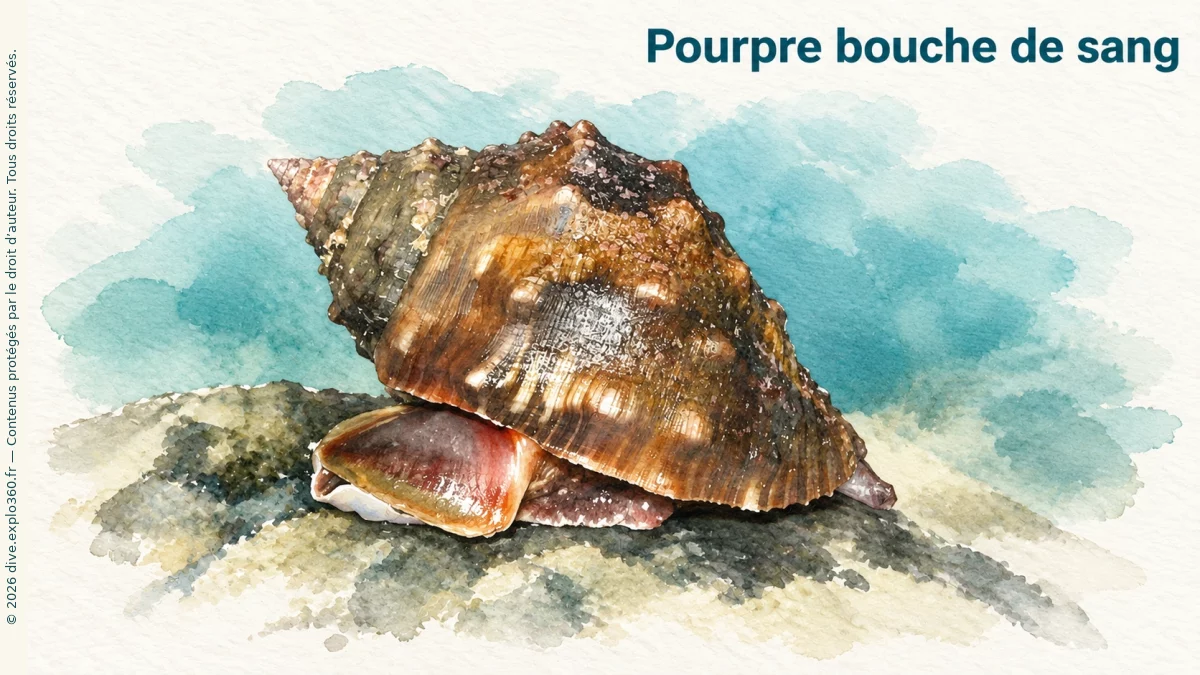
Its shell measures about four to eight centimetres. It is swollen, with a fairly low spire and a large final whorl carrying bumps rather than large spines.
The broad oval opening is orange-red. An operculum, a piece attached to the foot, closes the shell when the body withdraws. Attached organisms may partly hide the external sculpture.
WHERE DOES IT LIVE?
It mainly inhabits coastal rock, often in the first few metres, at wave-exposed sites. Deeper populations are also known.
Shelter availability and water movement influence its activity conditions alongside prey abundance.
WHAT DOES IT EAT?
It eats mussels, barnacles and limpets, among other prey. It can bore through their protection using its radula, a band of tiny teeth, and secretions.
A meal therefore often takes place on fixed prey. A motionless rock shell is not necessarily resting.
GO FURTHER WITH AMIGANSEAU
Unlock the full profile
Deepen your knowledge with the exclusive chapters and interactive resources included in an AMIGANSEAU licence.
- HOW DOES IT REPRODUCE?
- OUR OBSERVATIONS
- ARTICLE
Also included in the full profile
- Advanced navigation between description, ecological context, observations and behaviour
- Interactive food chain to explore the species’ feeding relationships