Habitat
 Depth
 Group
 Role
WHAT DOES IT LOOK LIKE?
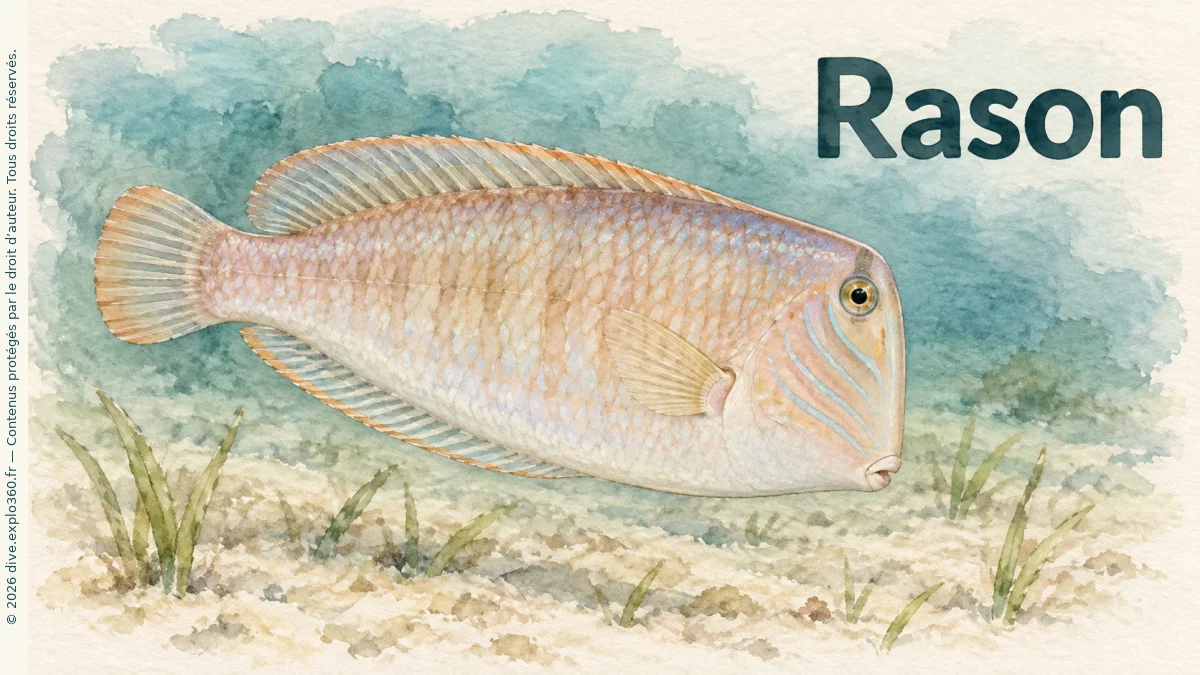
The pearly razorfish has an unusual profile for a wrasse: a narrow, abrupt forehead, a small high-set eye and a low mouth. The deep body is strongly flattened from side to side. A dorsal fin runs along most of the back, and the short tail lacks a pronounced fork.
There is no single colour pattern for the species. Young fish and females are often pale pink to whitish; males may become dull green with visible blue cheek lines. Lighting and posture substantially change their underwater appearance. The DORIS description gives a maximum length of 30 centimetres.
WHERE DOES IT LIVE?
This fish uses sandy expanses, sometimes broken by sparse patches of little Neptune grass. Sediment type and local conditions also matter.
Documented records include French Mediterranean coasts, notably Corsica, the French Riviera and Côte Bleue. The species also has a broad Atlantic distribution. At any one site, visibility depends on timing: an apparently empty sand flat can shelter buried fish.
WHAT DOES IT EAT?
It preys on invertebrates associated with loose seabeds. Recorded resources include crustaceans, molluscs and other small benthic animals. Several bivalves are explicitly named in natural-history references, establishing a feeding relationship with the sediment rather than merely a spatial association.
Food is sought close to the seabed. The small mouth contrasts with the high forehead: different parts of the head serve different functions. Prey comes from sediment-associated communities, while burial provides shelter. A witnessed capture should be distinguished from simple movement across a sandy patch.
GO FURTHER WITH AMIGANSEAU
Unlock the full profile
Deepen your knowledge with the exclusive chapters and interactive resources included in an AMIGANSEAU licence.
- HOW DOES IT REPRODUCE?
- OUR OBSERVATIONS
- ARTICLE
Also included in the full profile
- Advanced navigation between description, ecological context, observations and behaviour
- Interactive food chain to explore the species’ feeding relationships