 Habitat
 Depth
 Group
 Role
 Size
 Good to know
WHAT DOES IT LOOK LIKE?
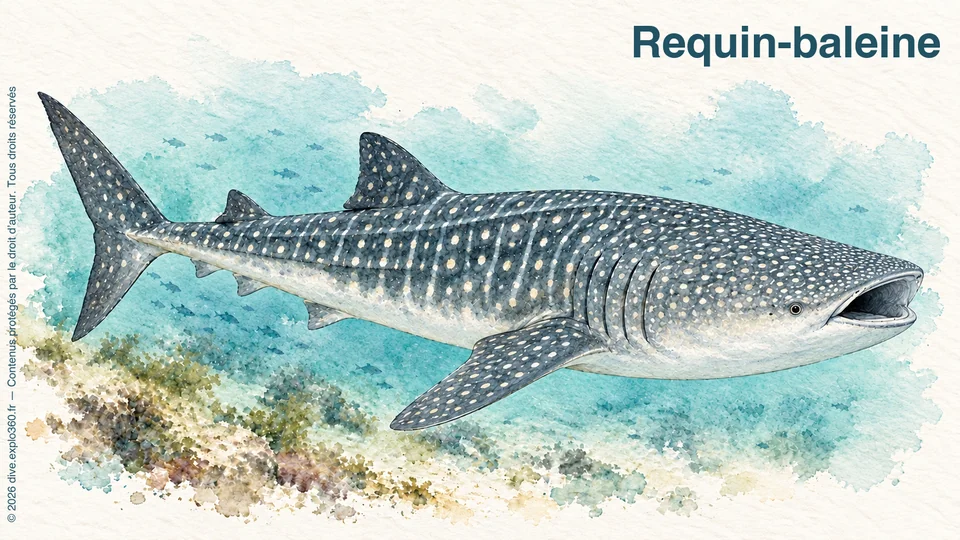
The broad mouth at the front of the head distinguishes the profile of the whale shark (Rhincodon typus). Its blue-grey back carries white spots and lengthways ridges; the belly remains pale. Five gill slits mark each side. This giant is the largest living fish.
WHERE DOES IT LIVE?
It lives in warm seas. In the Maldives it may pass near reefs and swim close to the surface. It also uses offshore and deep water. An animal seen near shore does not necessarily spend its whole life there.
Young sharks are monitored over several years around southern Ari Atoll. Tagging reveals substantial vertical movements. Surface conditions describe neither all depths visited nor the full area used.
WHAT DOES IT EAT?
Concentrations of small prey can feed the immense whale shark. It takes water into its large mouth by swimming or suction. The filtering apparatus retains food while water escapes through gill slits. Animal plankton, eggs and small fish are important resources. Feeding relies on collecting animals and particles distributed through water.
GO FURTHER WITH AMIGANSEAU
Unlock the full profile
Deepen your knowledge with the exclusive chapters and interactive resources included in an AMIGANSEAU licence.
Subscribing to Dive.Explo360 means supporting a different way to discover marine life.
Our independent platform is entirely self-funded and relies solely on subscriptions. Every licence helps us continue our work, create new content, and share what we know about the marine world with as many people as possible.
Starting at €80 per year, your support makes all the difference.
 Understand the species