


Partners and information

Contact us

Verification code

Whale sharkProtected

Distribution : Maldives and tropical Indian Ocean. Also found in the Red Sea and tropical Pacific. Also present in the tropical and subtropical Atlantic. Also found at Raja Ampat.

On India’s Gujarat coast, freeing a whale shark caught in a net can be costly for fishers, who may have to cut through the mesh. To encourage them, storyteller Morari Bapu drew on a familiar image, a married daughter returning to visit her parents. The whale shark was to be welcomed and protected as she was. It even received an affectionate name, Vhali, meaning “dear” or “beloved” in Gujarati.

Images being acquired · Your video or photos here

Habitat of Whale shark Habitat
Open water, Coral reef
Depth range of Whale shark Depth
0-1928 m
Biological group of Whale shark Group
Ecological role of Whale shark Role
Filter feeder, Predator

Size

Often 4–12 m; very large individuals exceed this range

Good to know

This species is legally protected in the Maldives. Do not swim in front of its head and keep clear of its tail: a movement by this very large animal can strike a swimmer.

WHAT DOES IT LOOK LIKE?

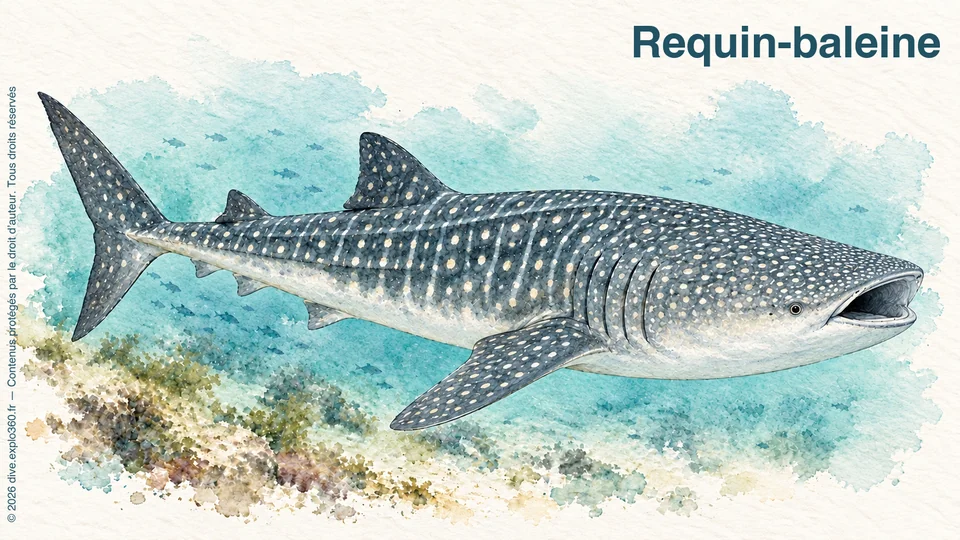
The broad mouth at the front of the head distinguishes the profile of the whale shark (Rhincodon typus). Its blue-grey back carries white spots and lengthways ridges; the belly remains pale. Five gill slits mark each side. This giant is the largest living fish.

WHERE DOES IT LIVE?

It lives in warm seas. In the Maldives it may pass near reefs and swim close to the surface. It also uses offshore and deep water. An animal seen near shore does not necessarily spend its whole life there.

Young sharks are monitored over several years around southern Ari Atoll. Tagging reveals substantial vertical movements. Surface conditions describe neither all depths visited nor the full area used.

WHAT DOES IT EAT?

Concentrations of small prey can feed the immense whale shark. It takes water into its large mouth by swimming or suction. The filtering apparatus retains food while water escapes through gill slits. Animal plankton, eggs and small fish are important resources. Feeding relies on collecting animals and particles distributed through water.

GO FURTHER WITH AMIGANSEAU

Unlock the full profile

Deepen your knowledge with the exclusive chapters and interactive resources included in an AMIGANSEAU licence.

Choose my licence
  • HOW DOES IT REPRODUCE?
  • OUR OBSERVATIONS
  • ARTICLE

Also included in the full profile

  • Advanced navigation between description, ecological context, observations and behaviour
  • Interactive food chain to explore the species’ feeding relationships
An active licence gives access to enriched profiles and AMIGANSEAU exploration tools.
Whale shark

Understand the species

What is this species’ ecological role?

AMIGANSEAU Explorer Premium

Access enriched species profiles with advanced content (audio, infographics and detailed articles).

Explore all species easily through a single interface.

Enjoy a smooth, fast learning experience suited to every level.

🔒 The full profile is available with a paid subscription only.

Discover licences

POURSUIVRE L’EXPLORATION

Explore further

ArticleWhat marine animals do and why it mattersRead the article →ArticlePHYLA WITHOUT THE FUSSRead the article →