


Partners and information

Contact us

Verification code

Scalloped hammerheadProtected

Distribution : Maldives and tropical Indian Ocean. Also found in the Red Sea and tropical Pacific. Also present in the tropical and subtropical Atlantic. Mediterranean: rare or exceptional records.

Sashimi, dried fish, fried pieces or briefly blanched meat: the scalloped hammerhead is among the sharks used in Japanese cooking. A publication from Japan’s National Museum of Nature and Science explains that, when handled fresh, its meat can have a texture reminiscent of red-fleshed fish, without the ammonia smell often associated with poorly preserved shark meat. Known as akashumokuzame, this animal belongs to a culinary history less familiar than its striking silhouette. Yet the details of that silhouette distinguish several species commonly grouped together under the name hammerhead shark.

Images being acquired · Your video or photos here

Habitat of Scalloped hammerhead Habitat
Open water, Coral reef
Depth range of Scalloped hammerhead Depth
0-512 m
Biological group of Scalloped hammerhead Group
Ecological role of Scalloped hammerhead Role
Predator

Size

Often 2–3 m; the largest exceed 4 m

Good to know

This species is legally protected in the Maldives. Observe from a distance without feeding, chasing or contact. Follow site guidance and leave a clear route.

WHAT DOES IT LOOK LIKE?

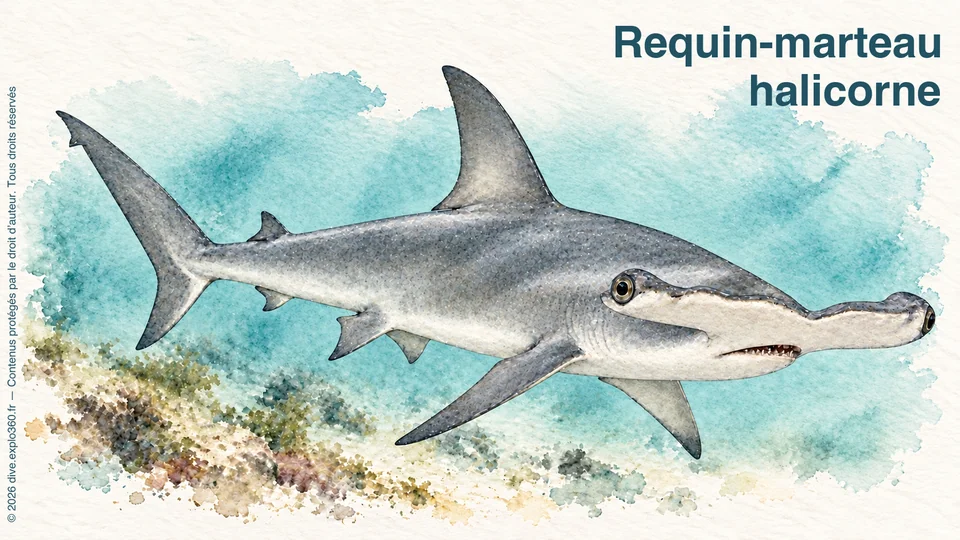
Indentations along the front edge shape the hammer of the scalloped hammerhead (Sphyrna lewini). This edge is curved, with a notch in the middle; the eyes lie at the far sides. The body, grey to brown above and pale below, is slimmer than that of the great hammerhead.

WHERE DOES IT LIVE?

It lives in warm seas across the Indian, Pacific and Atlantic oceans, as well as the Red Sea and the Maldives. Young sharks often use coastal waters. Larger individuals also use reef slopes and the waters around oceanic islands, where they may gather in schools.

WHAT DOES IT EAT?

Fish are an important part of the scalloped hammerhead’s food. Its menu also includes squid, octopuses and crustaceans. Consumption of rays and small sharks further broadens this diversity. Resources vary with location and animal size.

GO FURTHER WITH AMIGANSEAU

Unlock the full profile

Deepen your knowledge with the exclusive chapters and interactive resources included in an AMIGANSEAU licence.

Choose my licence
  • HOW DOES IT REPRODUCE?
  • OUR OBSERVATIONS
  • ARTICLE

Also included in the full profile

  • Advanced navigation between description, ecological context, observations and behaviour
  • Interactive food chain to explore the species’ feeding relationships
An active licence gives access to enriched profiles and AMIGANSEAU exploration tools.
Scalloped hammerhead

Understand the species

What is this species’ ecological role?

AMIGANSEAU Explorer Premium

Access enriched species profiles with advanced content (audio, infographics and detailed articles).

Explore all species easily through a single interface.

Enjoy a smooth, fast learning experience suited to every level.

🔒 The full profile is available with a paid subscription only.

Discover licences

POURSUIVRE L’EXPLORATION

Explore further

ArticleWhat marine animals do and why it mattersRead the article →ArticlePHYLA WITHOUT THE FUSSRead the article →