Habitat
 Depth
 Group
 Role
WHAT DOES IT LOOK LIKE?
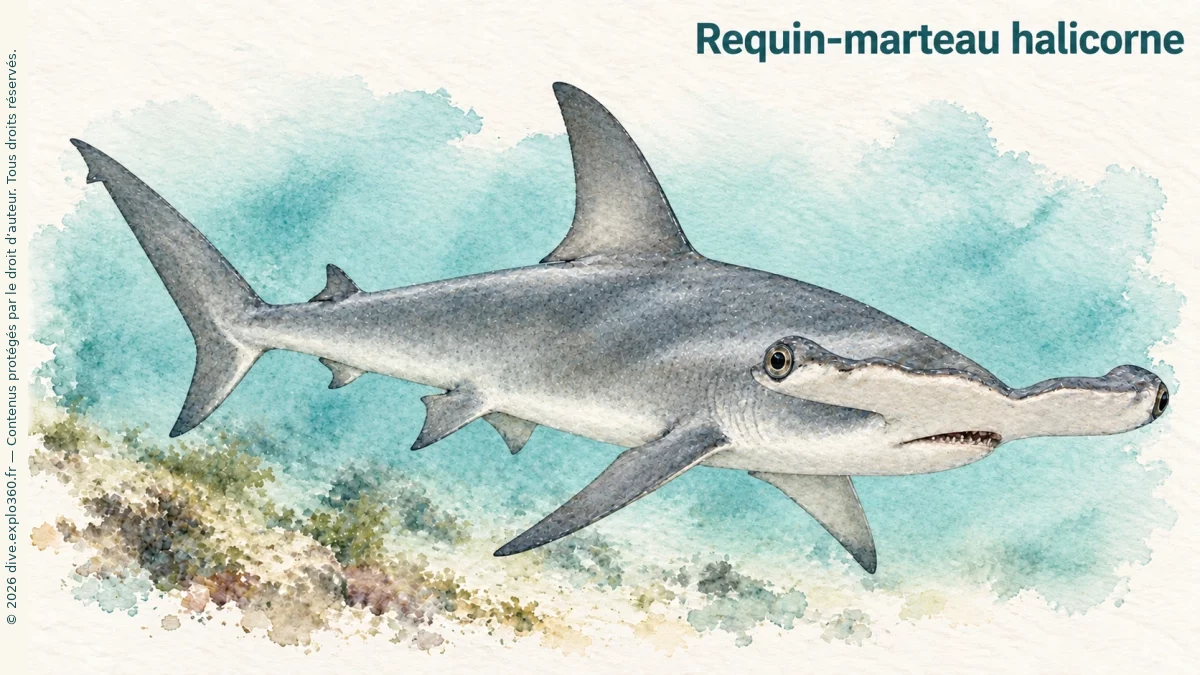
The head spreads sideways like a hammer. Its curved front edge has a central notch. Eyes sit at the ends. The back is grey to brown and the belly pale; the body is slimmer than a great hammerhead’s.
Indentations along the leading edge help distinguish the species. A distant outline does not always reveal them. The scientific name Sphyrna lewini identifies one species, not every shark with a hammer-shaped head.
WHERE DOES IT LIVE?
It swims in warm seas. Young sharks often use coastal water; larger animals may gather offshore. In the Mediterranean, its presence is rare or exceptional. It is documented in the Maldives, Red Sea and Indian, Pacific and Atlantic oceans. Schools are not continuously present everywhere.
Slopes and oceanic islands provide gathering sites in some regions. Usual habitat use can include deeper excursions. The frequently quoted 275 metres describes a usual range, not an absolute limit; deeper observations have been published.
WHAT DOES IT EAT?
It eats fish and squid. Organs on the head help it detect its surroundings. Crustaceans are also eaten. Prey and hunting areas change with body size.
Sight, smell and electroreception provide different information. The broad head is not simply a support for the eyes. Do not assign routine ray hunting solely from well-known behaviours of other hammerhead species.
GO FURTHER WITH AMIGANSEAU
Unlock the full profile
Deepen your knowledge with the exclusive chapters and interactive resources included in an AMIGANSEAU licence.
- HOW DOES IT REPRODUCE?
- OUR OBSERVATIONS
- ARTICLE
Also included in the full profile
- Advanced navigation between description, ecological context, observations and behaviour
- Interactive food chain to explore the species’ feeding relationships