Habitat
 Depth
 Group
 Role
WHAT DOES IT LOOK LIKE?
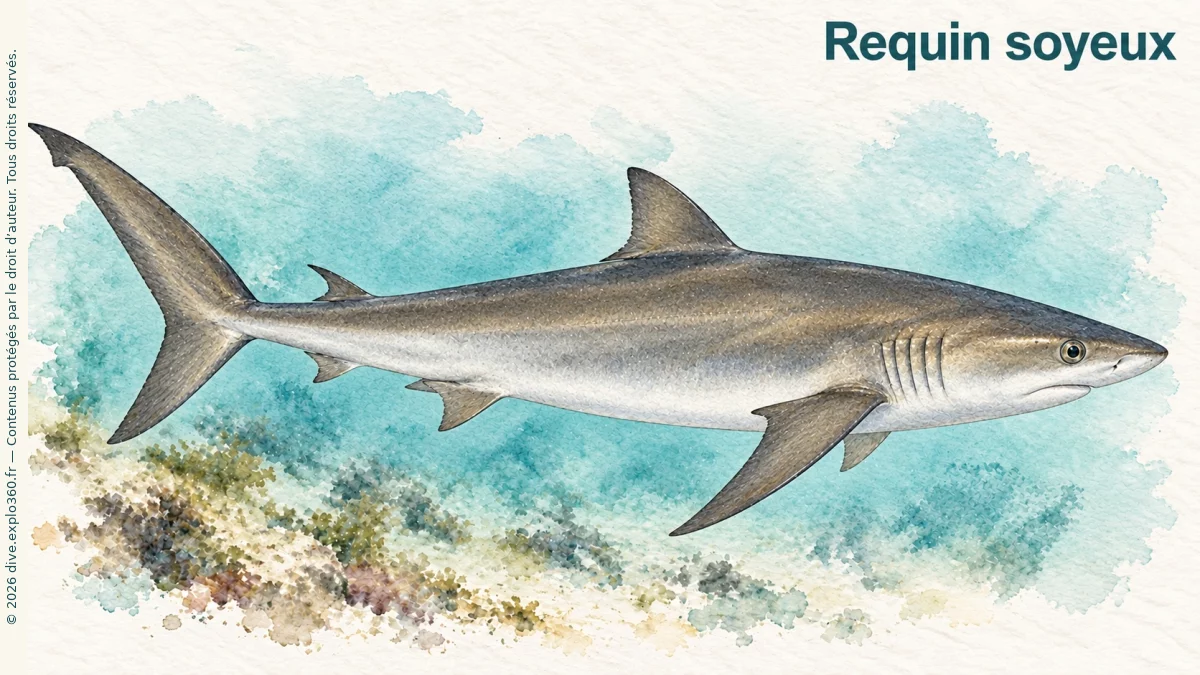
Its body is slender, grey-brown above and pale below. The pectoral fins are long. The first dorsal begins well back, behind the free rear tips of the pectorals. The second dorsal is much smaller.
That small dorsal has a long free rear extension. A low ridge runs between the dorsal fins. The skin’s supposedly silky feel is not a feature to test by hand. Identification relies on several visible traits.
WHERE DOES IT LIVE?
It swims in open water in warm seas. It occurs in the Maldives and the major tropical oceans. In the Mediterranean, its presence is rare or exceptional. It also uses oceanic drop-offs. Younger and older individuals do not always occupy the same depths.
It is documented in the Red Sea and Indian, Atlantic and Pacific oceans. A published range extends from the surface to roughly 500 metres. Seabed depth is not swimming depth: a shark two metres below the surface may be above a bottom thousands of metres down.
WHAT DOES IT EAT?
It mainly hunts fish. Squid and some crustaceans are also eaten. It can occur near tuna schools.
Pelagic resources and school movements influence hunting opportunities. Floating objects also attract individuals. Diet studies use evidence such as digestive contents.
GO FURTHER WITH AMIGANSEAU
Unlock the full profile
Deepen your knowledge with the exclusive chapters and interactive resources included in an AMIGANSEAU licence.
- HOW DOES IT REPRODUCE?
- OUR OBSERVATIONS
- ARTICLE
Also included in the full profile
- Advanced navigation between description, ecological context, observations and behaviour
- Interactive food chain to explore the species’ feeding relationships