Partners and information

Contact us

Verification code

Zebra shark

Distribution : Maldives and tropical Indian Ocean. Also found in the Red Sea and tropical Pacific. Also found at Raja Ampat.

When three zebra shark pups hatched at Townsville’s Reef HQ Aquarium in 2016, their mother, Leonie, had been separated from her former mate for several breeding seasons. The case was particularly intriguing because she had previously produced offspring through sexual reproduction. Long-term sperm storage offered one possible explanation, but genetic markers revealed a different origin. The story became even more remarkable with Leonie’s daughter, born through conventional fertilisation in 2009. Having reached maturity without encountering a breeding male, she too produced a pup. Two generations, two reproductive histories, and a mystery that researchers could investigate through DNA.

Images being acquired · Your video or photos here

Habitat of Zebra shark Habitat
Sand, Coral reef
Depth range of Zebra shark Depth
0-90 m
Biological group of Zebra shark Group
Ecological role of Zebra shark Role
Predator

Size

Usually 2–3 m including the long tail

Good to know

This species is legally protected in the Maldives. Observe from a distance without feeding, chasing or contact. Follow site guidance and leave a clear route.

WHAT DOES IT LOOK LIKE?

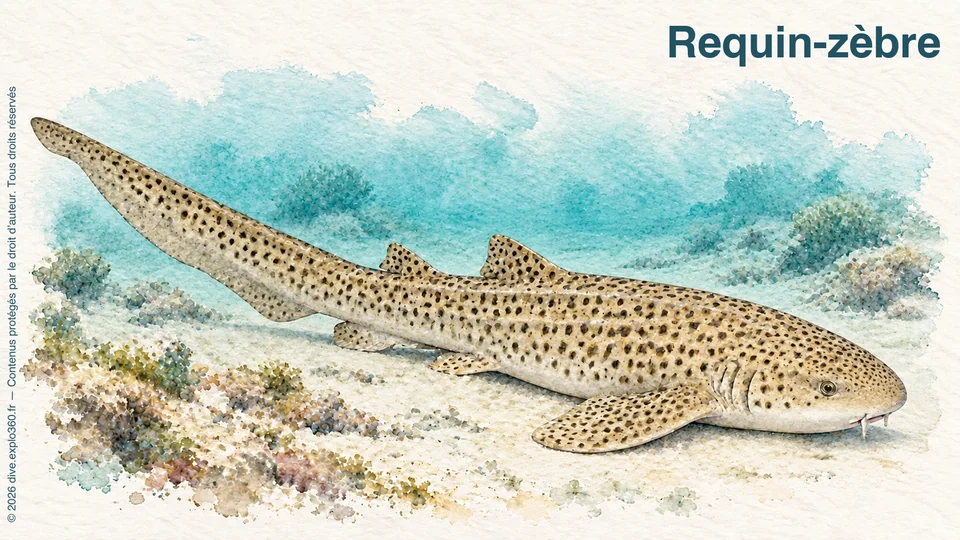
The very long tail extends the outline of the zebra shark (Stegostoma tigrinum). Adults are beige with dark spots and ridges on the back and sides; young sharks remain dark with pale bands. A rounded head and little appendages near the nostrils precede the two back fins, set far to the rear.

WHERE DOES IT LIVE?

It lives near the coast in tropical and subtropical waters of the Indian and Pacific oceans, including the Maldives. It uses sandy bottoms and rocky or coral reefs. During the day it may rest on the bottom beside a reef for long periods. Shallow coastal waters provide resting places.

WHAT DOES IT EAT?

Reef crevices supply some of the zebra shark’s nocturnal meals. It seeks molluscs and crustaceans, alongside small fish. Suction generated by mouth muscles draws prey inside. This technique exploits small resources on the seabed and within its crevices.

GO FURTHER WITH AMIGANSEAU

Unlock the full profile

Deepen your knowledge with the exclusive chapters and interactive resources included in an AMIGANSEAU licence.

Choose my licence
  • HOW DOES IT REPRODUCE?
  • OUR OBSERVATIONS
  • ARTICLE

Also included in the full profile

  • Advanced navigation between description, ecological context, observations and behaviour
  • Interactive food chain to explore the species’ feeding relationships
An active licence gives access to enriched profiles and AMIGANSEAU exploration tools.
Zebra shark

Understand the species

What is this species’ ecological role?

AMIGANSEAU Explorer Premium

Access enriched species profiles with advanced content (audio, infographics and detailed articles).

Explore all species easily through a single interface.

Enjoy a smooth, fast learning experience suited to every level.

🔒 The full profile is available with a paid subscription only.

Discover licences

POURSUIVRE L’EXPLORATION

Explore further

ArticleWhat marine animals do and why it mattersRead the article →ArticlePHYLA WITHOUT THE FUSSRead the article →