


 Habitat
 Depth
 Group
 Role
 Average size
WHAT DOES IT LOOK LIKE?
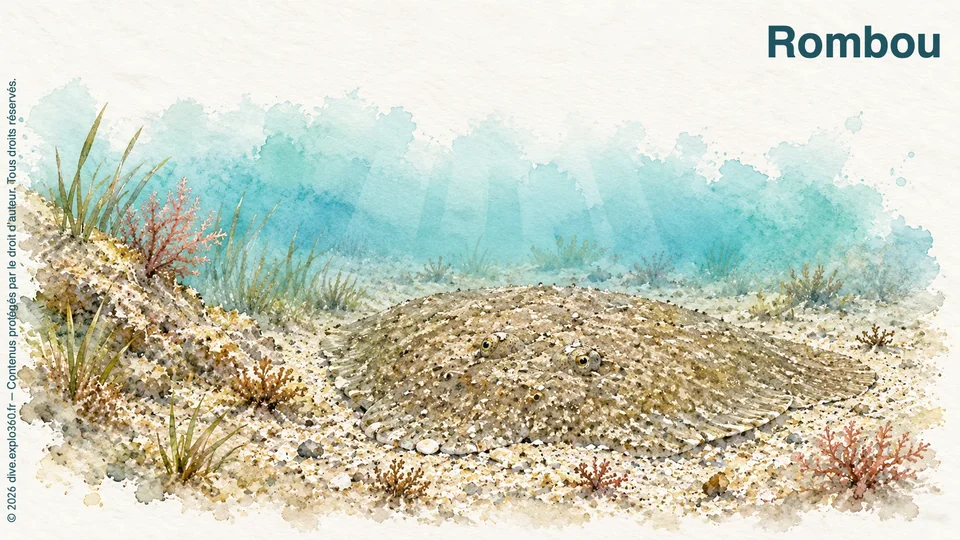
Widely spaced eyes distinguish the wide-eyed flounder (Bothus podas), especially in males. Both projecting eyes sit on the left side, one far forward near the mouth, above a broad and strongly flattened body.
Males have a fairly straight front profile, while females show a rounder outline. Long fins edge the body; the spotted upper side varies from beige to brown, while the lower side remains white.
WHERE DOES IT LIVE?
It mainly lives on soft seabeds such as sand or detrital areas, from shallow water down to several tens of metres. It spends most of its time motionless on the bottom, sometimes partly buried.
WHAT DOES IT EAT?
The wide-eyed flounder obtains much of its food from small mobile benthic crustaceans. Amphipods, isopods and cumaceans are important in Mediterranean digestive analyses. Worms, molluscs and small fish broaden the menu. Resources change among sites and seasons, and the fish uses prey available in its foraging area. Studies describe it as an active opportunistic predator. Although it is often seen on sand, it does not always lie still waiting for prey. Much of its recorded diet consists of small, mobile animals.
GO FURTHER WITH AMIGANSEAU
Unlock the full profile
Deepen your knowledge with the exclusive chapters and interactive resources included in an AMIGANSEAU licence.
- HOW DOES IT REPRODUCE?
- OUR OBSERVATIONS
- ARTICLE
Also included in the full profile
- Advanced navigation between description, ecological context, observations and behaviour
- Interactive food chain to explore the species’ feeding relationships
- Infographic and illustrated summary profile
- Additional photographic observations
 Understand the species