


 Habitat
 Depth
 Group
 Role
 Average size
WHAT DOES IT LOOK LIKE?
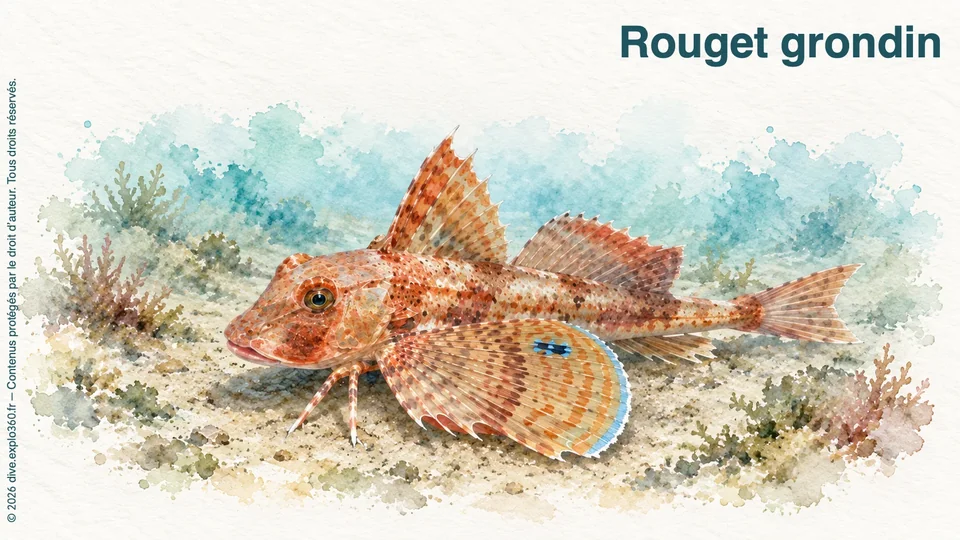
Blue edging on the inner faces of the broad side fins marks the tub gurnard (Chelidonichthys lucerna), though the blue fades with age. Beneath each fin, three rays detached from the membrane form little leg-like appendages.
The large, angular head contrasts with a body narrowing towards the tail. Two separate fins line the back, and small scales give the grey, brown or reddish colouring a smooth appearance.
WHERE DOES IT LIVE?
It mainly frequents soft seabeds such as sand, gravel or detrital areas, but can also be observed near rocks. It occurs from shallow water down to more than 200 metres.
WHAT DOES IT EAT?
The tub gurnard’s free rays do more than support movement across the seabed: their sensory receptors help locate prey. The snout can then probe sediment. Juveniles eat mainly crustaceans and small worms; fish become more important during growth. Molluscs, including cephalopods, may also be taken. Foraging therefore involves more than collecting small buried prey. Large individuals eat mobile animals near or above the seabed, with the balance of foods also depending on the population studied.
GO FURTHER WITH AMIGANSEAU
Unlock the full profile
Deepen your knowledge with the exclusive chapters and interactive resources included in an AMIGANSEAU licence.
- HOW DOES IT REPRODUCE?
- OUR OBSERVATIONS
- ARTICLE
Also included in the full profile
- Advanced navigation between description, ecological context, observations and behaviour
- Interactive food chain to explore the species’ feeding relationships
- Infographic and illustrated summary profile
 Understand the species