


 Habitat
 Depth
 Group
 Role
 Average size
WHAT DOES IT LOOK LIKE?
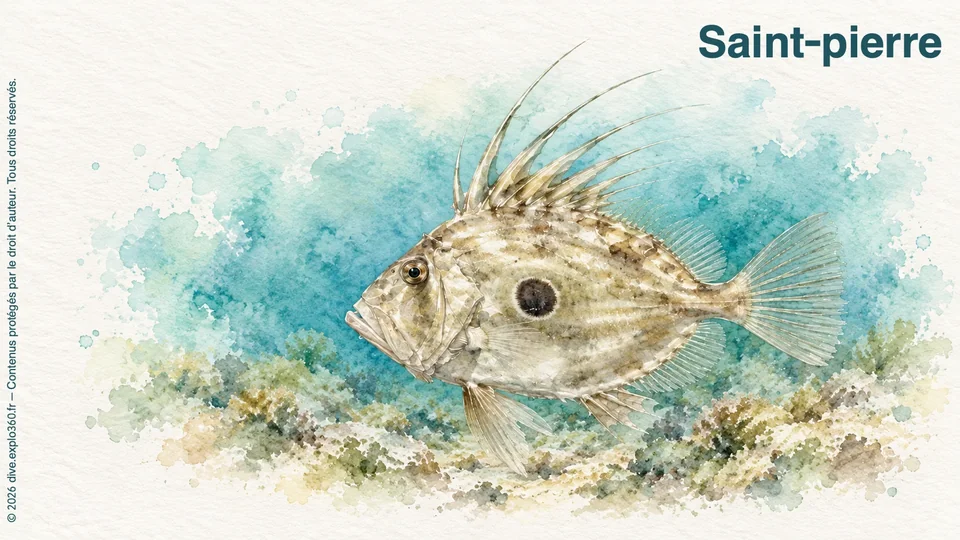
A large dark spot marks each side of the silvery John Dory (Zeus faber). Golden reflections may shade this almost round body, strongly flattened from side to side.
The bulky head ends in a highly extensible mouth that can project beyond the snout. Above it, long spiny back-fin rays give the outline a jagged appearance.
WHERE DOES IT LIVE?
It frequents both coastal areas and greater depths, over varied seabeds: sand, mud, rocks or seagrass beds. It is often observed between a few metres and more than 200 metres deep, generally near the bottom.
WHAT DOES IT EAT?
The John Dory may remain almost motionless facing prey, then slowly close the distance. Once within reach, its mouth shoots forward and engulfs the animal. Fish supply most food, with shrimps and cuttlefish also reported. The final movement is far shorter than the approach. Orientation towards prey and slow progress give context to the sudden mouth extension, whereas stillness alone does not identify a capture.
GO FURTHER WITH AMIGANSEAU
Unlock the full profile
Deepen your knowledge with the exclusive chapters and interactive resources included in an AMIGANSEAU licence.
- HOW DOES IT REPRODUCE?
- OUR OBSERVATIONS
- ARTICLE
Also included in the full profile
- Advanced navigation between description, ecological context, observations and behaviour
- Interactive food chain to explore the species’ feeding relationships
- Infographic and illustrated summary profile
- Additional photographic observations
 Understand the species