Habitat
 Depth
 Group
 Role
WHAT DOES IT LOOK LIKE?
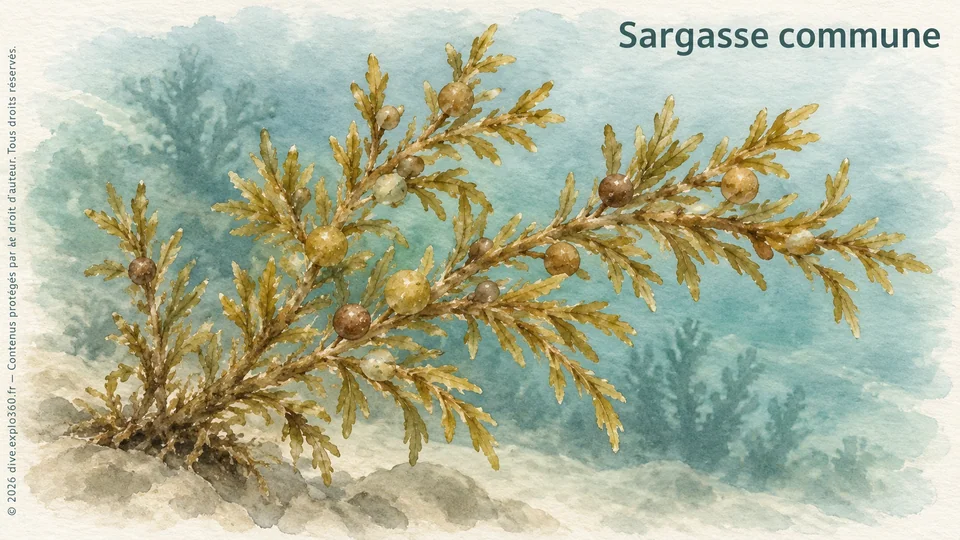
The common sargassum has a brown tree-like thallus, the algal body. A short axis from a disc-like base bears branches with pseudoleaves, leaf-like blades with a visible central rib. Edges are wavy or toothed.
Aerocysts are small hollow bladders contributing buoyancy. Receptacles, the fertile branch regions, differ in form and function. Several details must be combined for species identification.
WHERE DOES IT LIVE?
It attaches to Mediterranean rocks and hard surfaces. French records notably include Corsica. It is not uniformly distributed along the entire coast.
Upright parts can vary while the base persists. Branches provide surfaces and relief for other organisms, best described at community scale.
WHAT DOES IT EAT?
Photosynthesis uses light to produce organic matter from available carbon in water. Mineral nutrients are also absorbed.
Floats help position branches in water. These hollow bladders differ from receptacles bearing reproductive structures: they contribute to the alga’s physical arrangement.
GO FURTHER WITH AMIGANSEAU
Unlock the full profile
Deepen your knowledge with the exclusive chapters and interactive resources included in an AMIGANSEAU licence.
- HOW DOES IT REPRODUCE?
- OUR OBSERVATIONS
- ARTICLE
Also included in the full profile
- Advanced navigation between description, ecological context, observations and behaviour
- Interactive food chain to explore the species’ feeding relationships