DIVE.EXPLO360.FRObserve, understand, share
Diver services

You can also access AMIGANSEAU diver services. Sign in to these services with your email address and pairing code.

trouve-MOIIdentify an encounterExplorariumKeep and share your dive memories
ShopAMIGANSEAU ACCESS ↗
Partners and information

Contact us

Verification code

Zebra seabream

Distribution : Eastern Atlantic and Mediterranean. French Mediterranean records include the Riviera and Corsica; frequency varies between areas. Juveniles may use 1–2 m depths, adults rocky ground at 10–100 m or deeper.

A zebra seabream may first attract attention through its contrasting pattern, then disappear behind rocky relief. Beyond immediate recognition, its presence also reveals use of the coast: sheltered areas for juveniles and rocky passages at greater depth for many adults, with behaviour influenced by local conditions.

Habitat of Zebra seabream Habitat
Rocky habitat, Seagrass meadow, Sand, Wreck
Depth range of Zebra seabream Depth
1-300 m
Biological group of Zebra seabream Group
Ecological role of Zebra seabream Role
Predator

📏 Size

Commonly 10–40 cm; up to 55 cm

WHAT DOES IT LOOK LIKE?

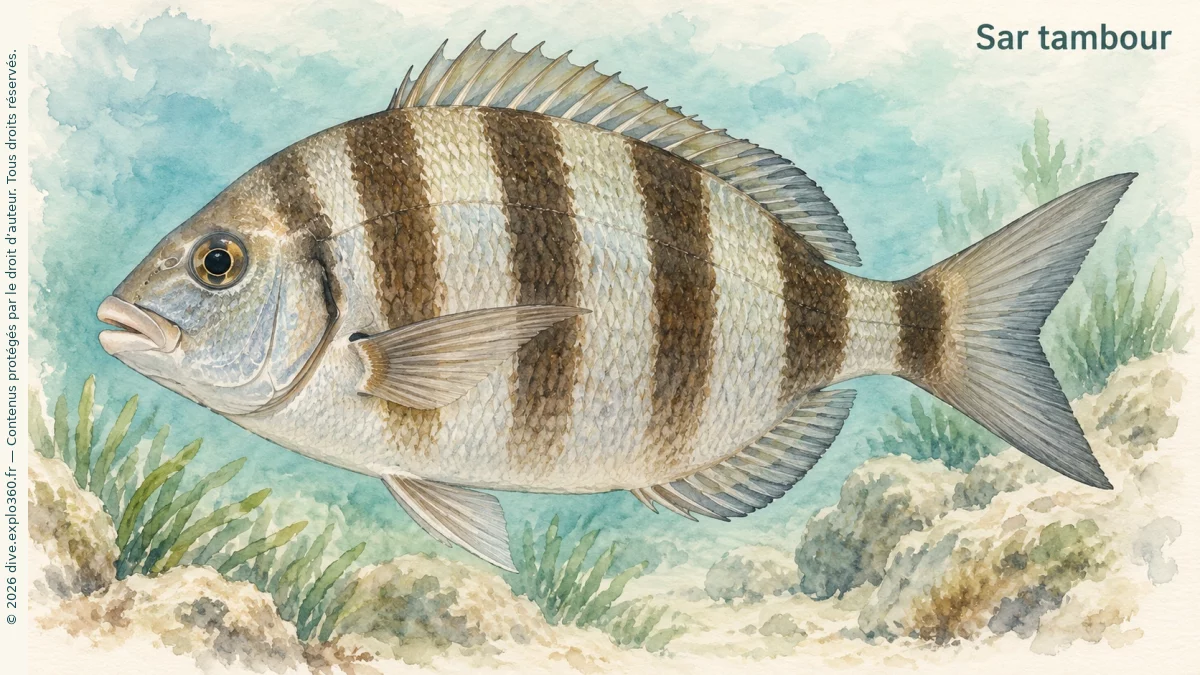
The zebra seabream is a seabream with an oval compressed body. Five broad dark vertical bands mark the silver flanks, the first before the dorsal fin and the last near the tail base. Thick lips, one long dorsal fin and a forked tail complete identification. Bands can become paler with the animal’s condition and surroundings. DORIS gives ordinary lengths of 10–40 centimetres and a maximum of 55 centimetres.

WHERE DOES IT LIVE?

Adults usually use rocky ground from the first tens of metres into deeper water. They may cross sand or occur on wrecks. Juveniles inhabit very coastal settings, sometimes in one or two metres, including seagrass and sand–rock boundaries. This habitat diversity should be considered together with developmental stage. Mediterranean frequency is uneven: records include the French Riviera and Corsica, without implying abundance at every site.

WHAT DOES IT EAT?

The dentition combines incisors and several rows of molars. Juveniles show a more broadly omnivorous diet, while adults mainly take bottom animals, including bivalves, sea urchins, polychaetes and crustaceans. These categories are not a complete list of possible prey. Inspecting the substrate or contacting a shell does not always demonstrate consumption; actual capture and processing should be distinguished from simple proximity.

GO FURTHER WITH AMIGANSEAU

Unlock the full profile

Deepen your knowledge with the exclusive chapters and interactive resources included in an AMIGANSEAU licence.

Choose my licence
  • HOW DOES IT REPRODUCE?
  • OUR OBSERVATIONS
  • ARTICLE

Also included in the full profile

  • Advanced navigation between description, ecological context, observations and behaviour
  • Interactive food chain to explore the species’ feeding relationships
An active licence gives access to enriched profiles and AMIGANSEAU exploration tools.
Zebra seabream

🧠 Understand the species

What is this species’ ecological role?

AMIGANSEAU Explorer Premium

Access enriched species profiles with advanced content (audio, infographics and detailed articles).

Explore all species easily through a single interface.

Enjoy a smooth, fast learning experience suited to every level.

🔒 The full profile is available with a paid subscription only.

Discover licences

POURSUIVRE L’EXPLORATION

Explore further

ArticleTHE SECRETS OF THE SEAGRASS MEADOWRead the article →ArticleTHE SECRETS OF SHIPWRECKSRead the article →JourneysJourney into the heart of wrecksDiscover → →