Habitat
 Depth
 Group
 Role
WHAT DOES IT LOOK LIKE?
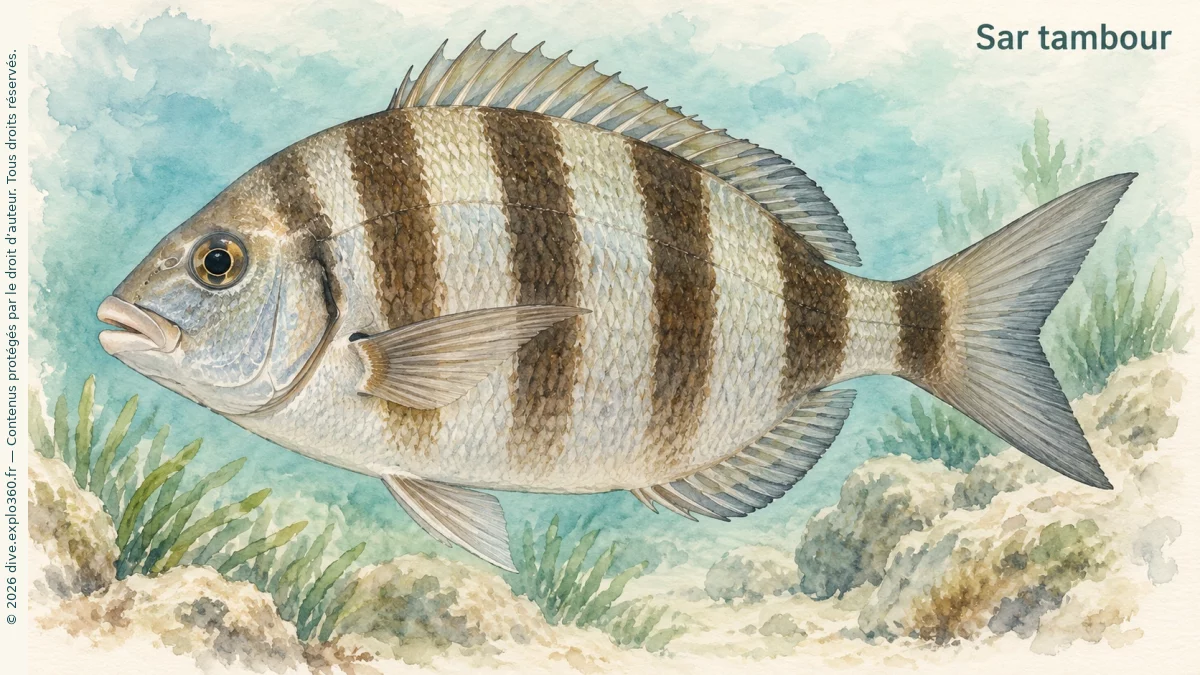
The zebra seabream is a seabream with an oval compressed body. Five broad dark vertical bands mark the silver flanks, the first before the dorsal fin and the last near the tail base. Thick lips, one long dorsal fin and a forked tail complete identification. Bands can become paler with the animal’s condition and surroundings. DORIS gives ordinary lengths of 10–40 centimetres and a maximum of 55 centimetres.
WHERE DOES IT LIVE?
Adults usually use rocky ground from the first tens of metres into deeper water. They may cross sand or occur on wrecks. Juveniles inhabit very coastal settings, sometimes in one or two metres, including seagrass and sand–rock boundaries. This habitat diversity should be considered together with developmental stage. Mediterranean frequency is uneven: records include the French Riviera and Corsica, without implying abundance at every site.
WHAT DOES IT EAT?
The dentition combines incisors and several rows of molars. Juveniles show a more broadly omnivorous diet, while adults mainly take bottom animals, including bivalves, sea urchins, polychaetes and crustaceans. These categories are not a complete list of possible prey. Inspecting the substrate or contacting a shell does not always demonstrate consumption; actual capture and processing should be distinguished from simple proximity.
GO FURTHER WITH AMIGANSEAU
Unlock the full profile
Deepen your knowledge with the exclusive chapters and interactive resources included in an AMIGANSEAU licence.
- HOW DOES IT REPRODUCE?
- OUR OBSERVATIONS
- ARTICLE
Also included in the full profile
- Advanced navigation between description, ecological context, observations and behaviour
- Interactive food chain to explore the species’ feeding relationships