Habitat
 Depth
 Group
 Role
WHAT DOES IT LOOK LIKE?
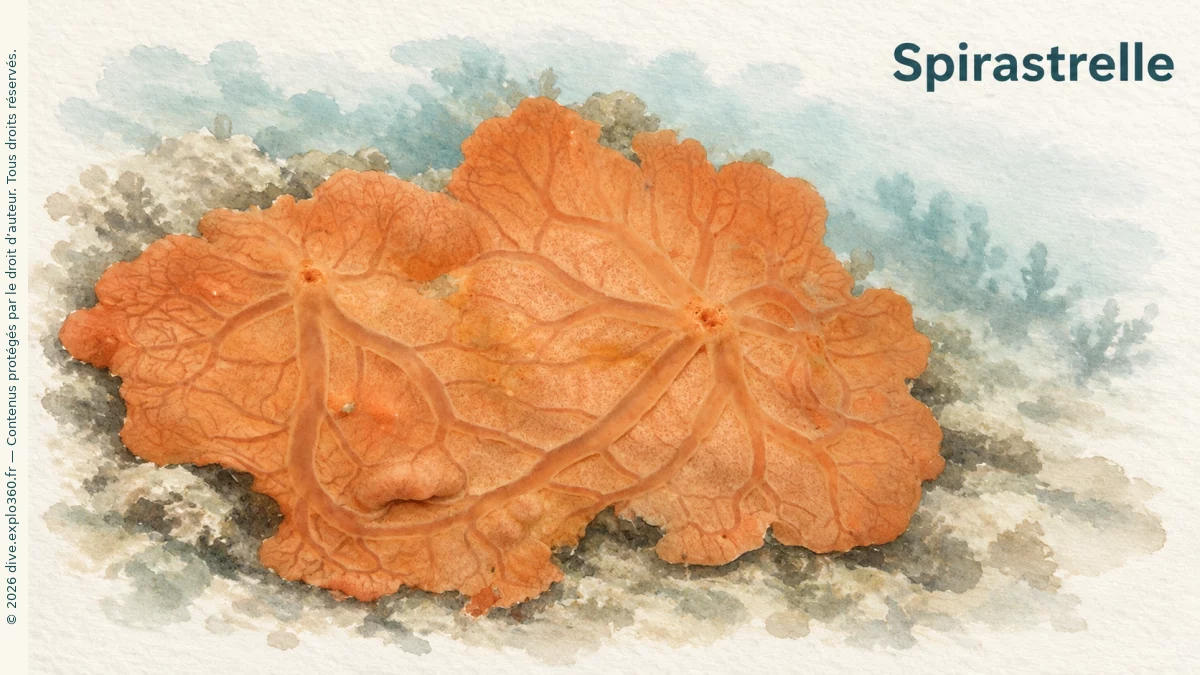
This encrusting species forms a layer a few millimetres thick, orange to pinkish red, following irregularities in the supporting surface. The finely grainy surface bears round, slightly raised oscula, the openings that release water. Visible channels converge on them.
The skeleton includes tylostyles, needles pointed at one end and swollen at the other, and spirasters, small spiny elements. These microscopic features are more precise than colour for confirming identification.
WHERE DOES IT LIVE?
It lives on dim rocky surfaces, beneath overhangs and in caves, including shallow water. French observations include Provence and Corsica.
In these settings, surface orientation matters alongside depth when describing light exposure. An overhanging rock can shelter a sponge very near the surface.
WHAT DOES IT EAT?
Numerous small pores admit water carrying food particles. Choanocytes, cells with a collar and a moving filament, contribute to pumping and food capture. Water then enters outgoing pathways leading to the oscula.
Food is processed within cells. Neither the large visible openings nor the raised channels are mouths or blood vessels.
GO FURTHER WITH AMIGANSEAU
Unlock the full profile
Deepen your knowledge with the exclusive chapters and interactive resources included in an AMIGANSEAU licence.
- HOW DOES IT REPRODUCE?
- OUR OBSERVATIONS
- ARTICLE
Also included in the full profile
- Advanced navigation between description, ecological context, observations and behaviour
- Interactive food chain to explore the species’ feeding relationships