


 Habitat
 Depth
 Group
 Role
 Size
 Good to know
WHAT DOES IT LOOK LIKE?
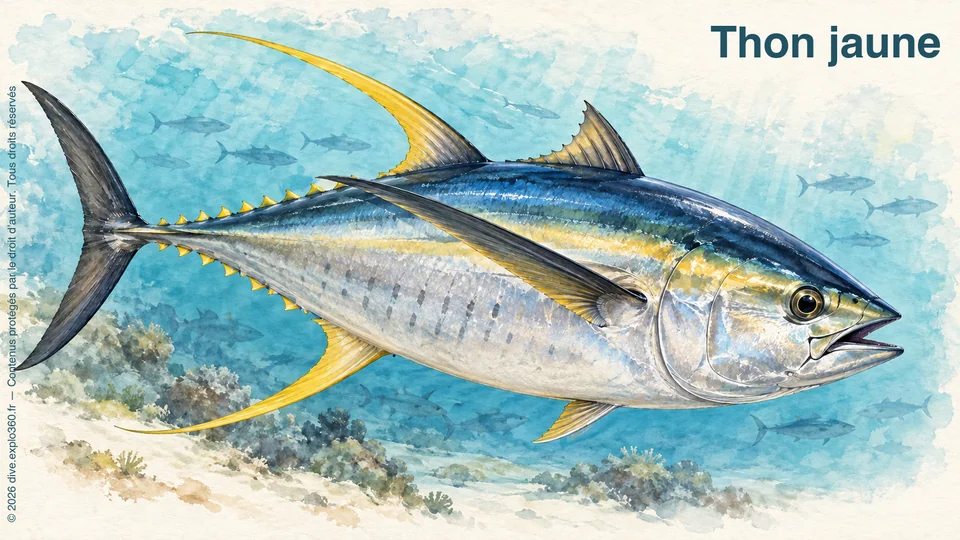
Vivid yellow fins highlight the yellowfin tuna (Thunnus albacares), especially the two long curved fins of large individuals. The forked tail sits on a narrow base, preceded by little isolated fins. Pale lines may mark the lower silver flanks. The largest reach about 239 cm from snout to tail fork.
WHERE DOES IT LIVE?
It lives in warm Atlantic, Indian and Pacific waters, including the Maldives. It is an open-ocean fish. It travels near the surface and through the layers below.
It mainly uses the upper few hundred metres. Some schools gather near floating objects or underwater oceanic features. It can make brief, very deep dives: a tag recorded 1602 m near Mexico’s Revillagigedo Islands. These excursions differ greatly from its usual time in upper waters.
WHAT DOES IT EAT?
Size changes the yellowfin tuna’s feeding opportunities. Small individuals take planktonic crustaceans, whereas larger fish consume fish, squid and other crustaceans. Greater ability to enter deeper water expands their available resources. Feeding occurs mainly by day, although night feeding is also known.
GO FURTHER WITH AMIGANSEAU
Unlock the full profile
Deepen your knowledge with the exclusive chapters and interactive resources included in an AMIGANSEAU licence.
- HOW DOES IT REPRODUCE?
- OUR OBSERVATIONS
- ARTICLE
Also included in the full profile
- Advanced navigation between description, ecological context, observations and behaviour
- Interactive food chain to explore the species’ feeding relationships
 Understand the species