Habitat
 Depth
 Group
 Role
WHAT DOES IT LOOK LIKE?
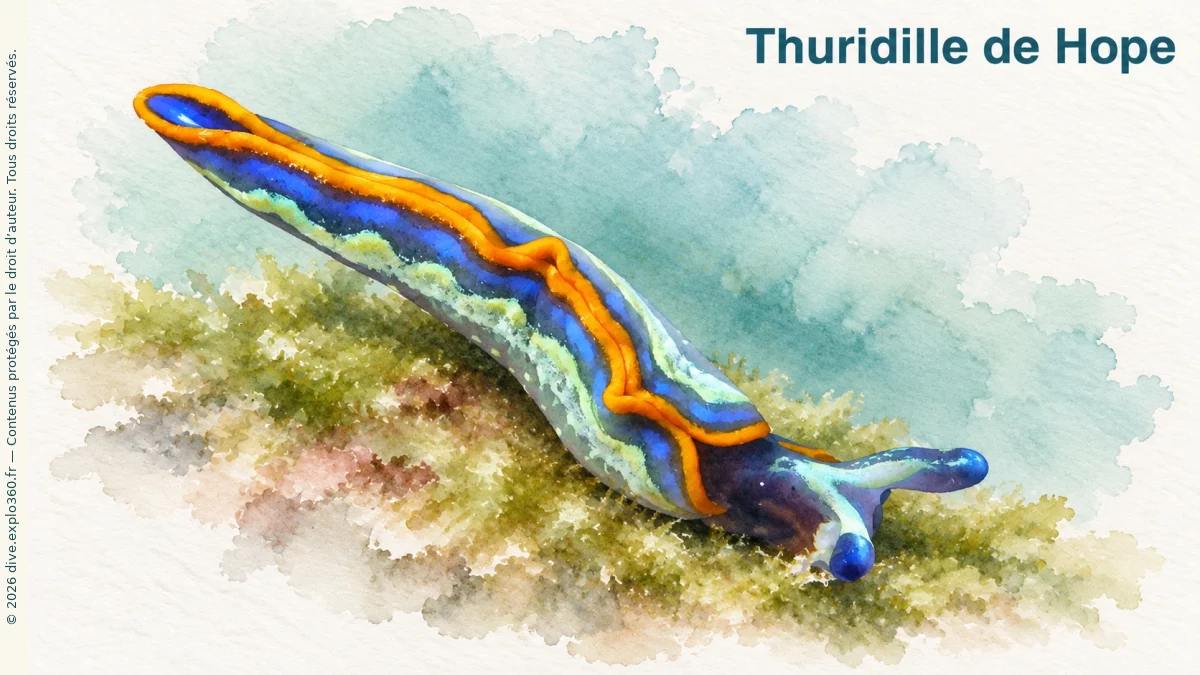
This slender slug measures ten to twenty-five millimetres. Two parapodia, folds on either side of the body, meet over the back to form a sheath. The head projects at the front with two rhinophores, rolled sensory organs detecting information in water.
The body is often blue to violet, but colours vary. Several lines border the folds, with the outer margin usually yellow or orange. Tiny black spots at the rhinophore bases are light-sensitive organs.
WHERE DOES IT LIVE?
It lives on rocky surfaces carrying algae, from shallow water to several tens of metres. It often uses well-lit areas.
It progresses by crawling. The side folds should not automatically be treated as swimming fins: regular adult swimming has not been established for this species.
WHAT DOES IT EAT?
It opens algal cells with its radula, the toothed mouth structure, then sucks out the contents. Green algae such as Cladophora vagabunda and Derbesia tenuissima are reported food resources.
This feeding method characterises sacoglossans, the group it belongs to. It differs from sponge consumption by several superficially similar dorids.
GO FURTHER WITH AMIGANSEAU
Unlock the full profile
Deepen your knowledge with the exclusive chapters and interactive resources included in an AMIGANSEAU licence.
- HOW DOES IT REPRODUCE?
- OUR OBSERVATIONS
- ARTICLE
Also included in the full profile
- Advanced navigation between description, ecological context, observations and behaviour
- Interactive food chain to explore the species’ feeding relationships