Habitat
 Depth
 Group
 Role
WHAT DOES IT LOOK LIKE?
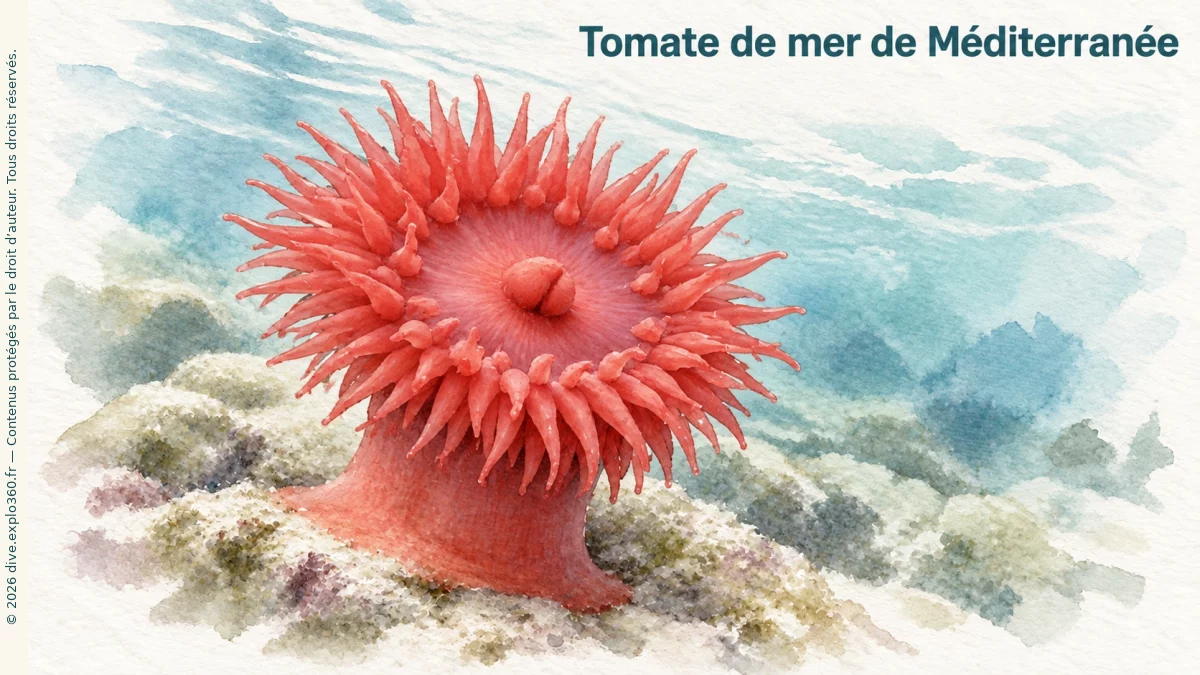
This anemone has a soft, smooth column, usually bright red. The broad adhesive base often has a blue margin. Large animals can reach five to seven centimetres across and around seven centimetres high.
When expanded, the oral disc, the mouth-bearing surface, shows a crown of many tentacles. These retract completely, allowing the body to close into a rounded mass resembling a tomato. Stinging vesicles lie beneath the tentacle crown’s edge.
WHERE DOES IT LIVE?
It attaches to rocks, breakwaters and quay walls near the surface and in the first few metres. Changes in sea level can expose it, even in the Mediterranean where tides are smaller than on some Atlantic coasts.
Closing limits the exposed surface, while mucus helps retain water. The base also allows slow movement.
WHAT DOES IT EAT?
It consumes small animals and fragments of animal food brought within tentacle reach. Stinging cells help capture and immobilise prey. Tentacles then guide food towards the central mouth.
Digestion occurs in an internal cavity. Undigested remains leave through the same opening: there are no separate mouth and anus. Expansion may occur at night or when conditions favour it, without a fixed timetable predicting every encounter.
GO FURTHER WITH AMIGANSEAU
Unlock the full profile
Deepen your knowledge with the exclusive chapters and interactive resources included in an AMIGANSEAU licence.
- HOW DOES IT REPRODUCE?
- OUR OBSERVATIONS
- ARTICLE
Also included in the full profile
- Advanced navigation between description, ecological context, observations and behaviour
- Interactive food chain to explore the species’ feeding relationships