DIVE.EXPLO360.FRObserve, understand, share
Diver services

You can also access AMIGANSEAU diver services. Sign in to these services with your email address and pairing code.

trouve-MOIIdentify an encounterExplorariumKeep and share your dive memories
ShopAMIGANSEAU ACCESS ↗
Partners and information

Contact us

Verification code

Common torpedo

Distribution : Mediterranean and eastern Atlantic. Mainly shallow soft-bottom encounters, with deeper records to 400 m.

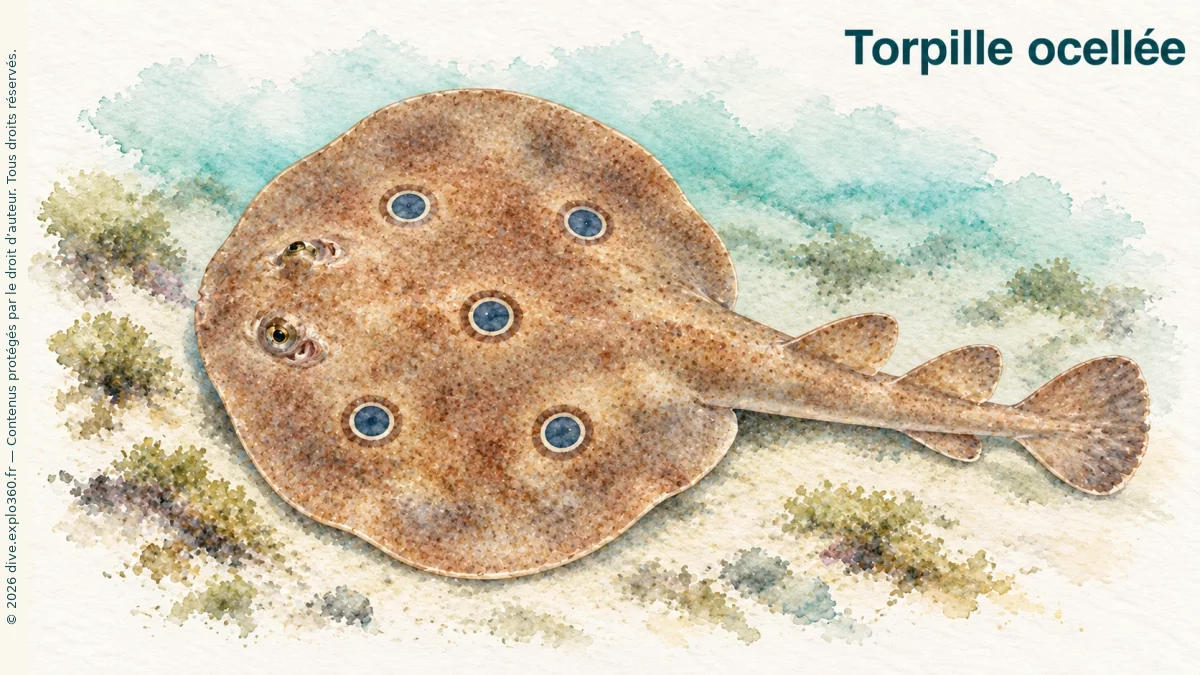
A torpedo ray can remain partly hidden in sand, while an exposed individual displays striking dorsal markings. Ocelli draw the observer’s eye; electrical physiology chiefly calls for separating observation from experiments on the animal.

Habitat of Common torpedo Habitat
Sand, Mud
Depth range of Common torpedo Depth
2-400 m
Biological group of Common torpedo Group
Ecological role of Common torpedo Role
Predator

📏 Size

Often 20–40 cm; published maximum 60 cm total length

ℹ️ Good to know

Can produce an electric discharge. Do not touch, uncover or handle.

WHAT DOES IT LOOK LIKE?

The common torpedo has a rounded thick disc and smooth skin. Brown upper colour often carries five blue ocelli ringed dark and pale, but numbers vary. Real eyes lie ahead of papillate spiracles. Two nearby dorsals and a terminal fin complete the robust tail. This differs from a stingray’s fine tail and barb.

WHERE DOES IT LIVE?

Mediterranean and eastern Atlantic soft bottoms, especially sand and sandy mud, provide habitat. Accounts extend from shallow water to 400 m. Burial and activity alter detectability.

WHAT DOES IT EAT?

Bottom fish are major food, supplemented by invertebrates. Lateral head organs use stacks of specialised cells to produce coordinated discharges for feeding and defence. A witnessed capture can be described, but a still image measures neither voltage nor current. Never seek contact to generate a discharge for illustration.

GO FURTHER WITH AMIGANSEAU

Unlock the full profile

Deepen your knowledge with the exclusive chapters and interactive resources included in an AMIGANSEAU licence.

Choose my licence
  • HOW DOES IT REPRODUCE?
  • OUR OBSERVATIONS
  • ARTICLE

Also included in the full profile

  • Advanced navigation between description, ecological context, observations and behaviour
  • Interactive food chain to explore the species’ feeding relationships
An active licence gives access to enriched profiles and AMIGANSEAU exploration tools.
Common torpedo

🧠 Understand the species

What is this species’ ecological role?

AMIGANSEAU Explorer Premium

Access enriched species profiles with advanced content (audio, infographics and detailed articles).

Explore all species easily through a single interface.

Enjoy a smooth, fast learning experience suited to every level.

🔒 The full profile is available with a paid subscription only.

Discover licences

POURSUIVRE L’EXPLORATION

Explore further

ArticleTHE SECRETS OF SANDRead the article →JourneysJourney into maerl and sandDiscover → →ArticleMarine Life, a World of RolesRead the article →