Habitat
 Depth
 Group
 Role
WHAT DOES IT LOOK LIKE?
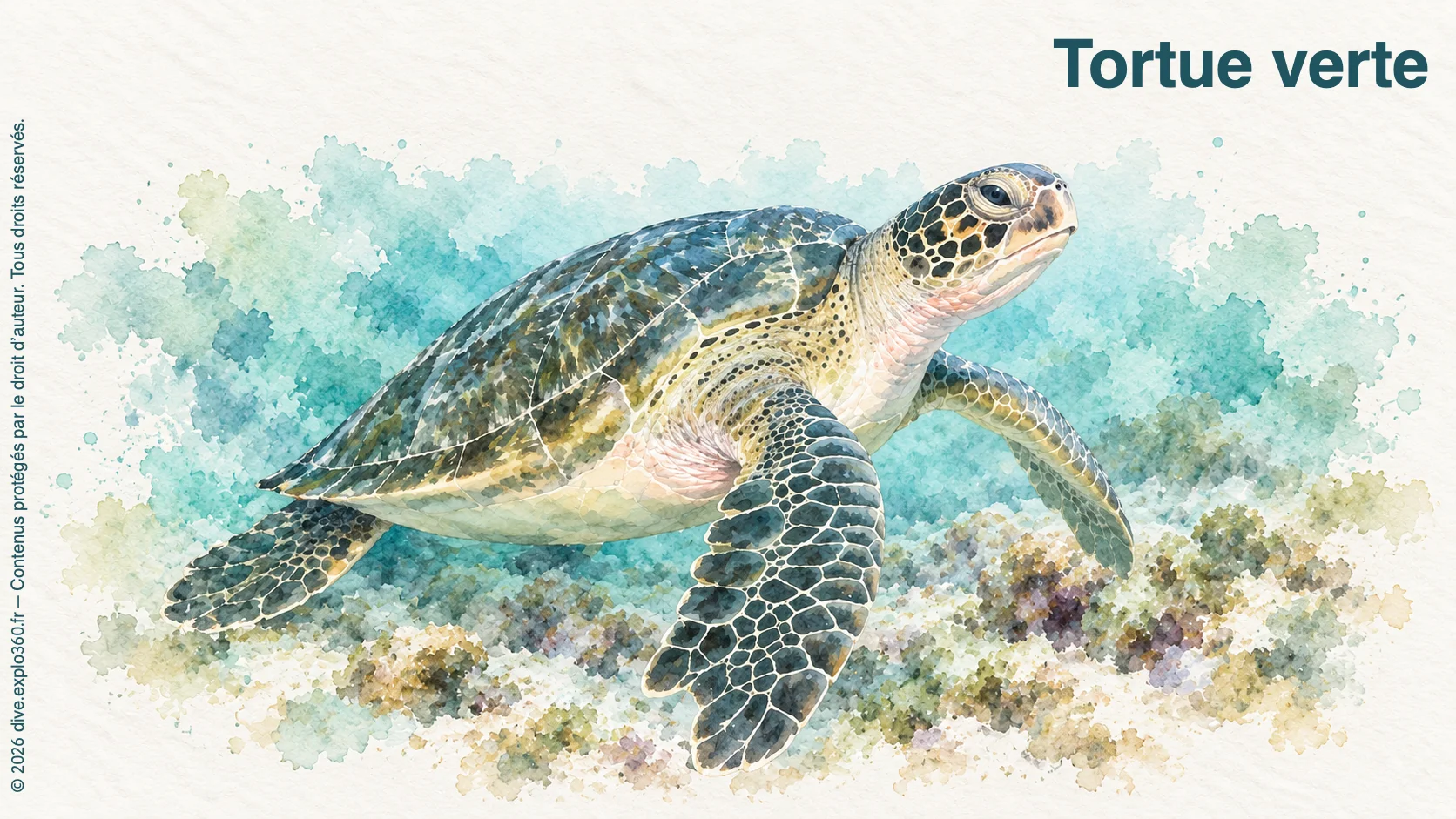
The rounded snout and adjoining shell plates differ from a hawksbill’s hooked beak and overlapping scutes. Adult shell length often lies around 80 to 120 cm; this is shell length rather than total body length.WHERE DOES IT LIVE?
Its habitats include seagrass beds, reefs and coastal waters. Movements and diving behaviour vary with activity and population. Its natural range spans several oceans and is not limited to the Maldives.WHAT DOES IT EAT?
Adults mainly consume seagrasses and algae, although diets differ among populations. Juveniles may eat more invertebrates. Feeding should therefore not be described as identical at every life stage.GO FURTHER WITH AMIGANSEAU
Unlock the full profile
Deepen your knowledge with the exclusive chapters and interactive resources included in an AMIGANSEAU licence.
- HOW DOES IT REPRODUCE?
- OUR OBSERVATIONS
Also included in the full profile
- Advanced navigation between description, ecological context, observations and behaviour
- Interactive food chain to explore the species’ feeding relationships
- Infographic and illustrated summary profile