


 Habitat
 Depth
 Group
 Role
 Average size
WHAT DOES IT LOOK LIKE?
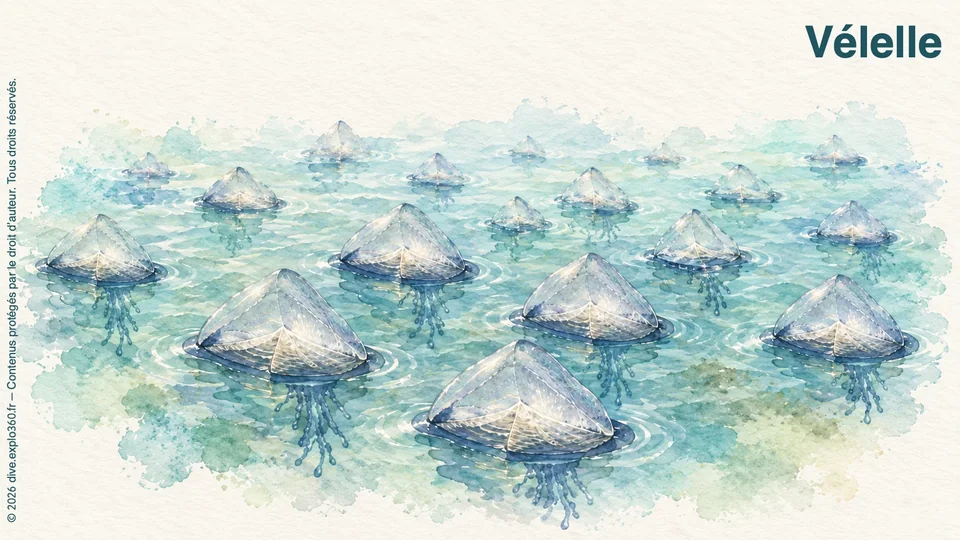
An angled sail rises above the flat, translucent blue base of the by-the-wind sailor (Velella velella). Its thin rigid wall gives the whole structure the outline of a little sailboat.
This form brings together a colony of small animals. It generally measures 2 to 7 cm.
WHERE DOES IT LIVE?
It lives at the surface in the open sea, carried by winds and currents. It occurs in many temperate areas, particularly the Mediterranean. Under favourable conditions, it may be brought towards the coast in large numbers, sometimes washing ashore en masse.
WHAT DOES IT EAT?
The sail is the by-the-wind sailor’s most conspicuous feature, but capture occurs below the float. Peripheral polyps carry tentacles armed with stinging cells. They take copepods, small gelatinous animals called appendicularians and fish eggs. Catches are passed to the central feeding polyp. The colony also receives organic material produced in light by its symbiotic microalgae. Prey capture and photosynthetic supply provide complementary routes of nutrition.
GO FURTHER WITH AMIGANSEAU
Unlock the full profile
Deepen your knowledge with the exclusive chapters and interactive resources included in an AMIGANSEAU licence.
- HOW DOES IT REPRODUCE?
- OUR OBSERVATIONS
- ARTICLE
Also included in the full profile
- Advanced navigation between description, ecological context, observations and behaviour
- Interactive food chain to explore the species’ feeding relationships
- Infographic and illustrated summary profile
 Understand the species