Habitat
 Depth
 Group
 Role
WHAT DOES IT LOOK LIKE?
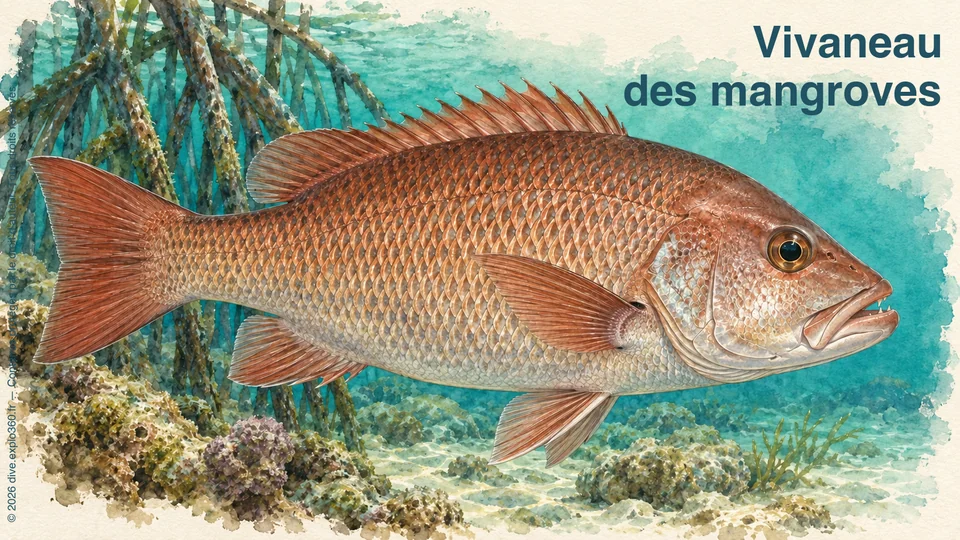
Its body is silvery grey, brown or reddish. The mouth is large and the rear edge of the tail almost straight. Dark centres on the scales form small diamond patterns. Blue lines may cross the cheek.
The body is oblong, meaning longer than it is deep, and flattened from side to side. The dorsal fin, the fin along the back, has a spiny front and a flexible rear. The mouth has canines, large pointed teeth at the front of the jaws. Young fish have paler vertical bars. Large fish may become strongly reddish. It reaches at least 1.20 m in length.
WHERE DOES IT LIVE?
It lives in warm waters of the Indian and Pacific Oceans, including the Maldives. Young fish inhabit mangroves, estuaries and sometimes lower river reaches. Adults also live around deeper reefs.
Its native range includes the Red Sea. It has also been recorded in the Mediterranean, which it reached from other seas. Adults find shelter beneath ledges and in reef caves. It tolerates different salinities, meaning different amounts of salt in the water. The fish can therefore move from coastal waters mixed with freshwater to marine reefs, where adults are known down to 120 m.
WHAT DOES IT EAT?
It eats fish, crabs and shrimps. It mainly hunts at night near the seabed and shelters. Pointed teeth hold its prey.
Fish and crustaceans (animals with a hard outer covering, such as crabs and shrimps) form most of its diet. Crustaceans are jointed animals protected by an outer covering, including crabs and shrimps. Its large mouth catches moving animals near reef structures. Available prey changes between the coastal habitats of young fish and reefs occupied by adults.
GO FURTHER WITH AMIGANSEAU
Unlock the full profile
Deepen your knowledge with the exclusive chapters and interactive resources included in an AMIGANSEAU licence.
- HOW DOES IT REPRODUCE?
- OUR OBSERVATIONS
- ARTICLE
Also included in the full profile
- Advanced navigation between description, ecological context, observations and behaviour
- Interactive food chain to explore the species’ feeding relationships