DIVE.EXPLO360.FRObserve, understand, share
Diver services

You can also access AMIGANSEAU diver services. Sign in to these services with your email address and pairing code.

trouve-MOIIdentify an encounterExplorariumKeep and share your dive memories
ShopAMIGANSEAU ACCESS ↗
Partners and information

Contact us

Verification code

Dwarf eelgrass

Distribution : Mediterranean and northeast Atlantic. The 0–1.5 m interval represents common shallow habitat described by DORIS, not an absolute physiological limit. Accepted name follows WoRMS; Nanozostera noltei is a synonym in that reference.

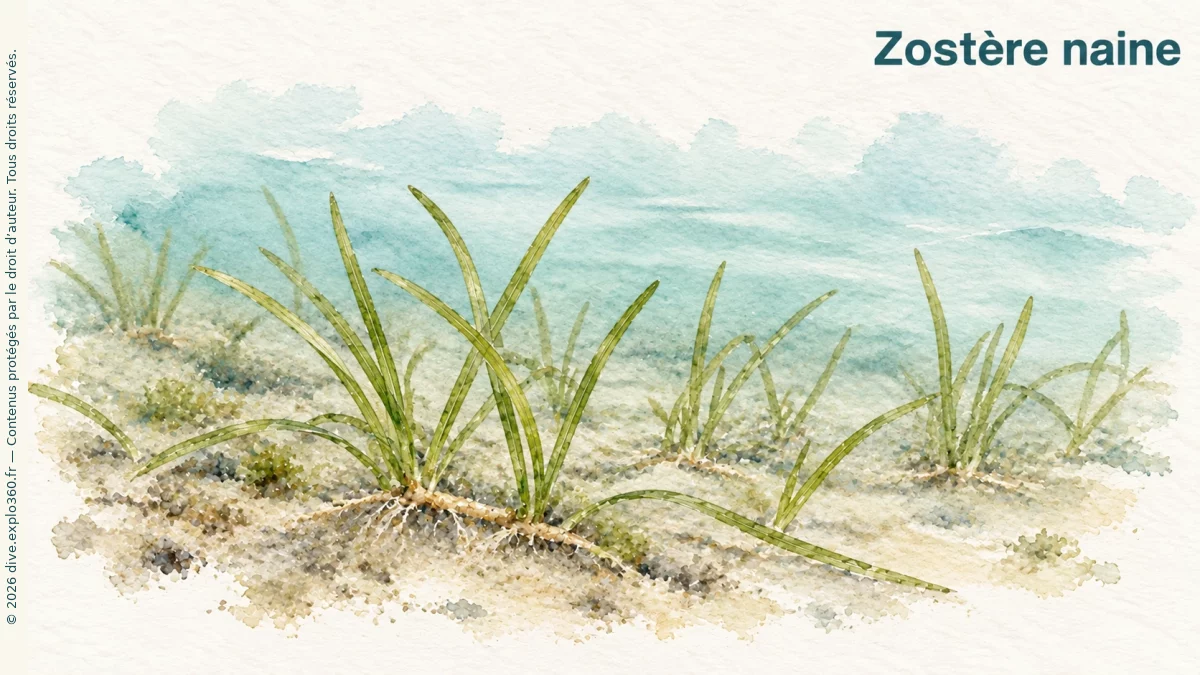
Dwarf eelgrass meadows remain low but contain organised networks of roots and rhizomes. Encounters often begin in a few decimetres of lagoon water. Recognising a flowering plant rather than a green carpet changes how the bottom is understood.

Habitat of Dwarf eelgrass Habitat
Sand, Mud
Depth range of Dwarf eelgrass Depth
0-1.5 m
Biological group of Dwarf eelgrass Group
Ecological role of Dwarf eelgrass Role
Primary producer, Ecosystem engineer

📏 Size

Leaves to about 20 cm, 1–1.5 mm wide

WHAT DOES IT LOOK LIKE?

The dwarf eelgrass has pale green flat ribbon leaves about 1–1.5 mm wide and up to roughly 20 cm long. Three longitudinal veins cross smooth-edged blades. A creeping rooted rhizome links shoots. Narrow leaves and overall size distinguish it from Neptune grass and broader-leaved species. Colour alone varies with lighting and material growing or deposited on leaves.

WHERE DOES IT LIVE?

Mediterranean lagoons and northeast Atlantic shores hold documented populations. Very shallow sandy mud is characteristic. The metadata interval of 0–1.5 m represents common DORIS habitat rather than an absolute species limit. Salinity, turbidity, exposure and immersion should be considered together. Depth alone cannot explain meadow condition.

WHAT DOES IT EAT?

Photosynthesis turns light energy and mineral resources into organic matter. Dissolved nutrients support growth. Roots and rhizomes anchor the plant and help retain sediment, while leaves add underwater structure. Producer and habitat-engineer roles describe these functions, but do not quantify local production, storage or stability without an appropriate method.

GO FURTHER WITH AMIGANSEAU

Unlock the full profile

Deepen your knowledge with the exclusive chapters and interactive resources included in an AMIGANSEAU licence.

Choose my licence
  • HOW DOES IT REPRODUCE?
  • OUR OBSERVATIONS
  • ARTICLE

Also included in the full profile

  • Advanced navigation between description, ecological context, observations and behaviour
  • Interactive food chain to explore the species’ feeding relationships
An active licence gives access to enriched profiles and AMIGANSEAU exploration tools.
Dwarf eelgrass

🧠 Understand the species

What is this species’ ecological role?

AMIGANSEAU Explorer Premium

Access enriched species profiles with advanced content (audio, infographics and detailed articles).

Explore all species easily through a single interface.

Enjoy a smooth, fast learning experience suited to every level.

🔒 The full profile is available with a paid subscription only.

Discover licences

POURSUIVRE L’EXPLORATION

Explore further

ArticleTHE SECRETS OF SANDRead the article →JourneysJourney into maerl and sandDiscover → →ArticleMarine Life, a World of RolesRead the article →