


Observe and identify
Underwater footage helps people spot species and observe them in their environment.
Observe · Share · Pass on knowledge
Do you film or photograph underwater life? Your videos and photos can enrich the Dive.Explo360 species guides and help explore a new sea.
A dive site, a species not yet on the platform, a particular behaviour or a different habitat: every observation can become a starting point for discovering and understanding marine biodiversity.
Let’s talk about your footage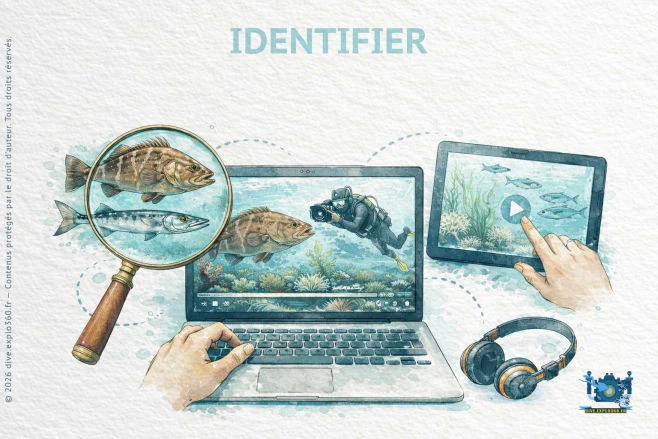
A project open to the seas and oceans
Dive.Explo360 grew from a Mediterranean collection. The platform was designed to gradually accommodate observations from other seas and oceans.
Divers, videographers and photographers can support this expansion by sharing their videos and photos. Their images help us create educational resources about observing and understanding marine life.
Contributions to Dive.Explo360 are unpaid. Contributing videographers and photographers receive:
Everyone can discover the people behind the footage and explore more of their work.
Using the submitted footage and available knowledge, a new region can develop a collection of interconnected content.
Underwater footage helps people spot species and observe them in their environment.
Profiles, habitat information and articles provide reference points for understanding what the footage shows.
Learning paths connect discoveries. When enough content is available, games help people recognise species and remember what they have learnt.
There is no need to have hundreds of videos from the outset. The first footage can lead to the first identifications, then the first profiles.
As the library grows, new educational content can be offered: articles, learning paths and games. Each sea develops at its own pace, according to the observations and resources available.
Meet the videographers and photographers who help explore and share knowledge of marine biodiversity. Each profile presents their work, the seas they explore and links to their website and social media.
Our contributorsWe are looking for natural history footage showing species clearly in their environment, preferably with:
Clear observations and natural history value take priority over production effects.
We also welcome high-quality wildlife photographs in JPG format (.jpg or .jpeg), at their original resolution and without excessive compression. A good underwater photograph makes the species stand out and shows the features needed to observe and identify it.
With your photographs, include the location, date and, if possible, depth and species name. Tell us how you would like to be credited. Only submit images you took and can authorise us to use.
Let’s start a conversation
Contact us to discuss it. Tell us about the sea or site you filmed, the species and behaviours observed, and the footage you would like to contribute.
Contact Dive.Explo360