


The canal that links two seas

Before the Suez Canal opened on 17 November 1869, a strip of land separated the two seas. The canal made a permanent route, but very salty water in the Bitter Lakes and fresh water from the Nile made it hard for some fish to cross. Water exchange, the Aswan High Dam and later work on the canal changed those conditions. The spread of species through Suez over successive generations is called Lessepsian migration, after Ferdinand de Lesseps.
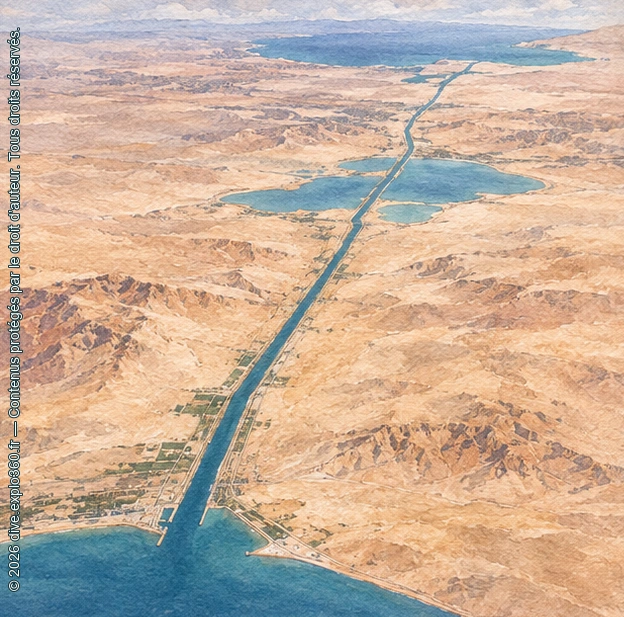
Schematic aerial view. A canal through the desert with the Bitter Lakes widening along it.
The Bitter Lakes lie on the route between the two seas. © 2026 dive.explo360.fr — Contenus protégés par le droit d’auteur. Tous droits réservés.
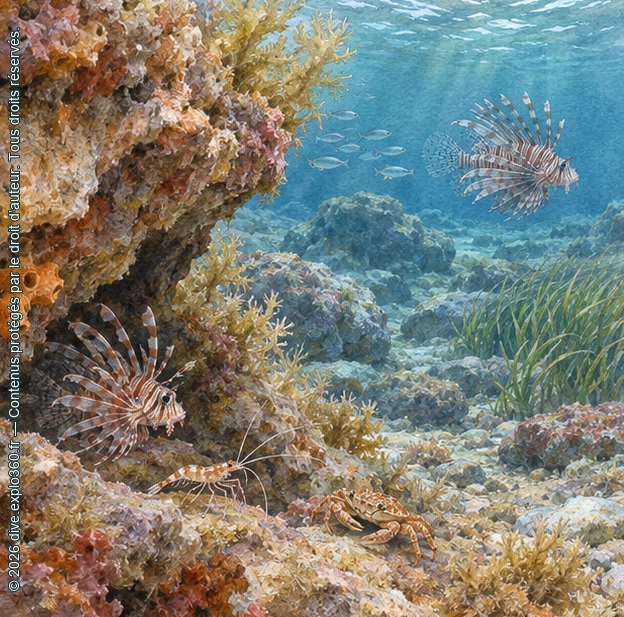
Reef and shelters. Two lionfish, rock crevices and crustaceans.
Rock crevices shelter young fish. Crustaceans can provide food. © 2026 dive.explo360.fr — Contenus protégés par le droit d’auteur. Tous droits réservés.

From a sighting to a population

A fish that reaches the Mediterranean still needs food, shelter and a temperature it can tolerate. If its young survive and breed in turn, a population can take hold. A first sighting tells you a fish was there. It may have arrived alone, or others may have been there for years before anyone spotted them. A varied diet and the use of different habitats can help it survive.

Lionfish become established

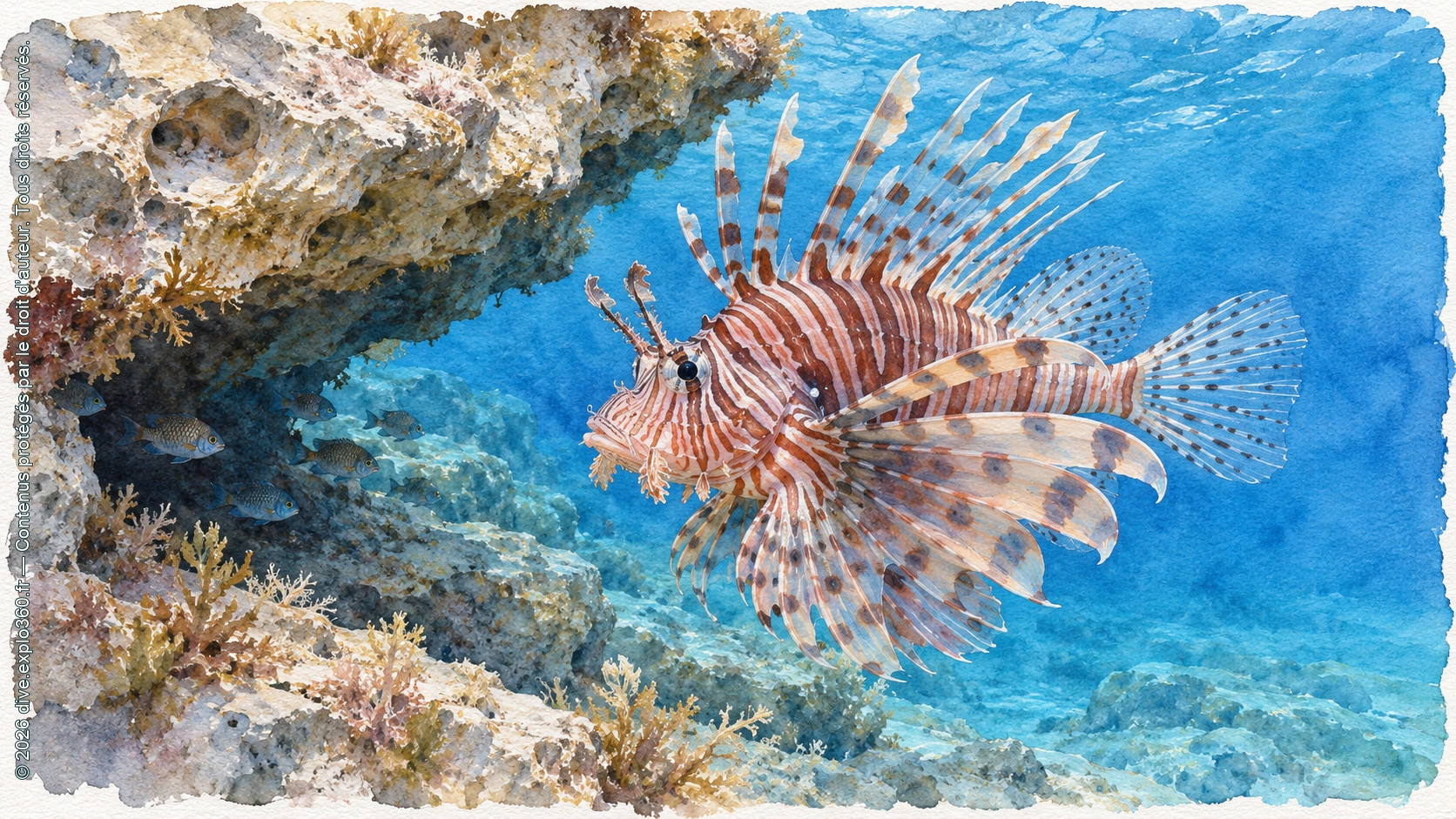
After an isolated record off Israel in 1991, two lionfish were reported off Lebanon in 2012. Sightings then multiplied from Cyprus to Turkey and Greece. Young fish and breeding adults show that populations had become established, especially around Cyprus. Lionfish use natural and artificial shelters, eat fish and crustaceans, carry venomous spines and breed over a long season, especially in warm months.
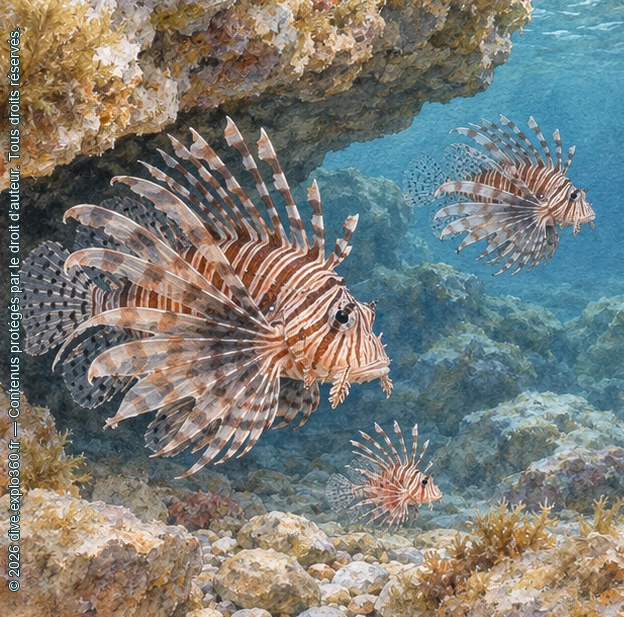
Adults and juvenile. Two larger lionfish and a smaller one beneath the rock.
Different sizes give a clue that can be examined alongside evidence of breeding. © 2026 dive.explo360.fr — Contenus protégés par le droit d’auteur. Tous droits réservés.
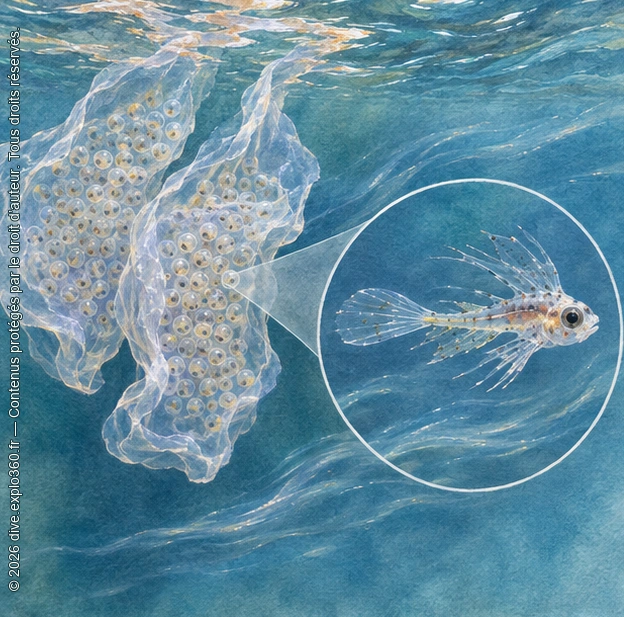
Dispersal diagram. Transparent egg masses and a magnified young lionfish.
The eggs are released in jelly-like masses. The close-up shows a drifting young fish. © 2026 dive.explo360.fr — Contenus protégés par le droit d’auteur. Tous droits réservés.

Currents carry the young

Lionfish release their eggs in jelly-like masses. Currents can carry the young far from the reefs where the adults live. If they survive and breed on another coast, their own young can travel onwards. Cold water or a lack of food or shelter can break that chain. Sightings in Sicily, Malta, the Adriatic and Sardinia tell us where lionfish have been seen. In 2026, most evidence of lasting populations comes from the east.

GO FURTHER WITH AMIGANSEAU

Continue reading

Discover full species guides, in-depth content and interactive tools available with your licence.

Your subscription helps preserve our independence.

Dive.Explo360 is an independent, self-funded nonprofit. Every licence helps us create new content, improve our teaching tools and keep some of our resources free and ad-free.

Licences from €80 per year

Choose a licence that suits your needs for personal, educational or professional use.

Open-access resources remain available without a subscription.

Scientific references

These papers examine the crossing through Suez, the drift of young fish and the effects of predation and grazing. An isolated sighting cannot establish a breeding population.

Vagenas, G. et al. (2024). Decoding the spread of non-indigenous fishes in the Mediterranean Sea. Scientific Reports, 14, 6669.doi.orgBottacini, D. et al. (2024). Lionfish (Pterois miles) in the Mediterranean Sea: a review of the available knowledge with an update on the invasion front. NeoBiota, 92, 233–257.doi.orgBernardi, G. et al. Invasion genomics of lionfish in the Mediterranean Sea (2024). Ecology and Evolution, 14, e11087.doi.orgSavva, I. et al. They are here to stay: the biology and ecology of lionfish (Pterois miles) in the Mediterranean Sea (2020). Journal of Fish Biology.pubmed.ncbi.nlm.nih.govSchilling, H. T. et al. (2024). Testing passive dispersal as the key mechanism for lionfish invasion in the Mediterranean Sea using Lagrangian particle tracking. Biological Invasions, 26, 505–514.doi.orgGrowth and reproductive dynamics of the devil firefish, Pterois miles, in the Eastern Mediterranean Sea (2025, publication dans le volume 2026). Journal of Fish Biology.doi.orgSala, E. et al. Alien Marine Fishes Deplete Algal Biomass in the Eastern Mediterranean (2011). PLOS ONE, 6, e17356.doi.orgVergés, A. et al. Tropical rabbitfish and the deforestation of a warming temperate sea (2014). Journal of Ecology.doi.orgHuseyinoglu, M. F. et al. Assisted recovery of Mediterranean native fish species by removal of two established invasive alien species, Pterois miles and Diadema setosum (2024). Estuarine, Coastal and Shelf Science, 304, 108826.doi.org